
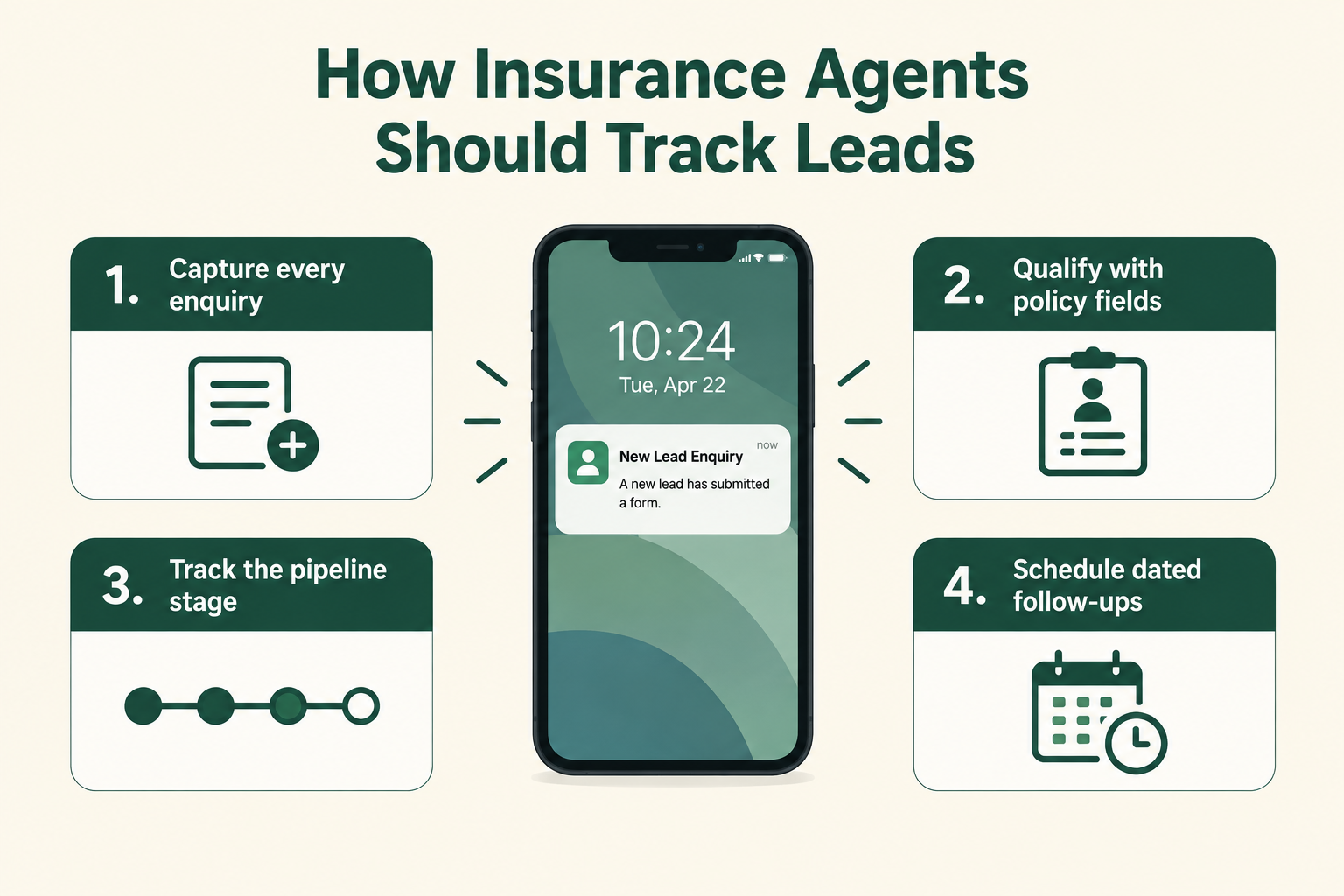
Insurance runs on details. A policy enquiry is not one conversation — it is a first call, a qualification, KYC documents, a quote, a comparison, maybe two weeks of nudging, and finally a policy issued or a silent drop-off. Track any of those steps in your head, and things slip: the callback you forgot, the document that never arrived, the lead who was ready last Tuesday and bought elsewhere by Friday.
This guide breaks lead tracking into six practical steps, none of which require a memory upgrade.
1. Track the Lead From the Moment It Arrives
You cannot track what you never captured. Every enquiry — Facebook or Instagram lead ad, Google lead form, your website, a referral, a walk-in at a branch — should land in one place as its own record, with the source attached.
The source matters later: it is how you learn whether your ad spend produces issued policies or just enquiries. A lead that arrives in your inbox, gets read, and lives in a WhatsApp thread has no source, no history, and no owner — it only exists as long as you remember it.
2. Record What Actually Qualifies the Lead
For tracking to be useful, each lead record should hold the fields that decide whether this is a real opportunity: policy type, sum assured, age, budget band, health disclosures, and the documents still outstanding.
Write them as actual structured fields you can filter and report on, not free-text notes buried after twenty messages. “KYC pending” typed in a note is a fact you know; a Documents Received checkbox left unchecked is a fact the system reminds you about.
3. Give Every Lead One Owner
Unassigned leads are the first place business leaks. When a lead has a name against it, someone notices when the callback slips. When it does not, everyone assumes someone else called.
If you work solo this is automatic — but set the owner anyway, so that when you add an agent or an assistant later, the history and ownership are already in place instead of living in your phone.
4. Log Every Call and Conversation
Most insurance conversations happen by phone and WhatsApp, which is exactly why they vanish. If call logging depends on typing notes after every dial, it stops within a week — and the next person to touch the lead starts from zero.
Track conversations where they happen:
- Automatic call logging on Android: incoming, outgoing and missed calls synced with talk duration, matched to the lead. An answered call can even auto-complete the pending callback task.
- WhatsApp from the lead record, so chats connect to the enquiry instead of being scattered across your personal thread list.
The test is simple: open any lead and see its full history in ten seconds. If you cannot, tracking is not really happening.
5. Track the Pipeline, Not Just the Status
“Hot”, “warm” and “cold” tell you almost nothing two weeks later. Track the stage the lead is actually in:
New → Contacted → Qualified → Documents Pending → Quote Sent → Negotiation → Won / Lost
Now your tracking produces answers: how many quotes are pending a decision, how many leads are stuck waiting on documents, and where enquiries pile up before dropping off. Add a lost reason when you close it — “premium too high”, “bought elsewhere”, “no response” — and after a month you can see the pattern instead of guessing it.
6. Schedule the Follow-Up Before You End the Conversation
The last line of every call or chat should set the next dated action: “sending the comparison today, checking in Thursday.” A dated follow-up that surfaces as a phone notification is what turns intent into a tracked commitment — versus a mental note that competes with forty others.
The same principle runs the second insurance clock, renewals. Every policy you issue creates a follow-up due next year. A Renewal Date field with follow-ups scheduled against it means your renewal book works itself instead of surfacing only when a client calls to say they lapsed.

What to Look at Weekly
Four numbers, five minutes:
- First-response time — how long new enquiries waited for a personal reply.
- Leads with no next action — the silent leak; every open lead should have one.
- Stage conversion — contacted → qualified → quote → issued.
- Outcomes by source — which ads and channels produce policies, not just enquiries.
How Ridhzo Fits This
Ridhzo is a mobile-first lead CRM with insurance as a documented use case. It supports capture from Meta Lead Ads, Google lead form ads, website webhooks, hosted form links and CSV import; custom fields like Policy Type, Sum Assured, Renewal Date and Documents Received; automatic Android call sync with talk duration and caller ID for active leads; one-tap WhatsApp from the lead card; WHEN → IF → THEN automations; and reporting on first-response time and outcomes by source. The free plan covers a solo advisor (1 user, 300 leads); Starter is ₹249/month for 3 users, and Unlimited is ₹449/month with no caps. GST extra, and WhatsApp Business API conversation fees are billed by Meta or your provider.
FAQ
How many times should I follow up on an insurance lead? A structured cadence for roughly 10–14 days — calls and WhatsApp alternated and spaced out — then slower nurture. Stop actively chasing when asked to, but keep “not now” leads on a light check-in list; timelines change, and many policies close months later.
Do I need a CRM, or is a spreadsheet enough? A spreadsheet works while volume is low, one person owns it, and updates are disciplined. It breaks when multiple people handle enquiries, leads arrive across several channels, or follow-ups depend on someone checking a due-date column. The move is worth making before renewal tracking piles on top of enquiry tracking.
Can I track renewals too? Yes — with a Renewal Date field and follow-ups scheduled against it, renewals surface as dated reminders weeks before they lapse, instead of living in a diary.
Will it log my calls automatically? On Android, yes — incoming, outgoing and missed calls sync automatically with talk duration, and answered calls auto-complete pending follow-ups.