
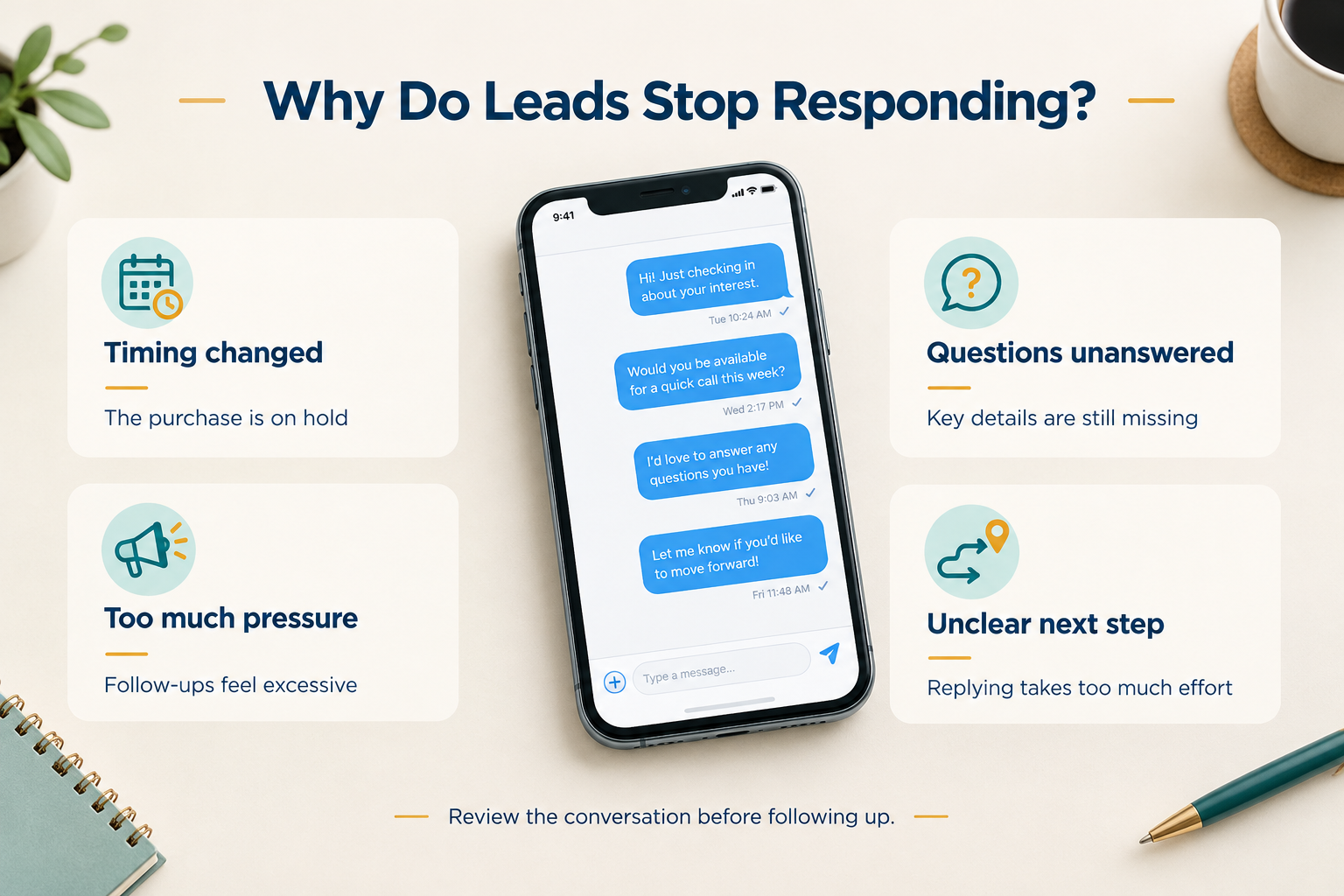
Leads may stop responding because their priorities changed, they are unsure about the offer, your messages do not address their questions, or the next step feels too demanding. Some are still comparing options. Others have decided against buying without telling you.
Silence alone cannot tell you which explanation applies.
Before sending another reminder, review the conversation. What did the person request? Did your team answer it? What was supposed to happen next?
Those questions help you choose a useful follow-up and recognise when it is time to stop.
1. Their Buying Timeline Has Changed
An enquiry shows interest at a particular moment. It does not guarantee that someone is ready to purchase immediately.
A homeowner may postpone a renovation. A business may delay a software purchase until its budget is approved. Someone researching a course may decide to join a later intake.
If your messages keep pushing for an immediate decision, they may no longer fit the person’s situation.
What to Do
Ask about timing without assuming the sale is lost.
Hi Priya, when we spoke, you were considering a kitchen renovation this month. Is that still the plan, or has the timing changed?
If they request a later callback, record the agreed date and pause routine reminders. Do not keep sending messages aimed at someone ready to buy now.
2. You Have Not Answered Their Main Question
A prospect asks about pricing and receives a brochure. They ask whether you serve their area and receive an invitation to book a call.
Your team has responded, but the prospect still lacks the information they need.
Review whether the conversation actually addressed the enquiry. A fast reply can still leave the central question unanswered.
What to Do
Answer what you can directly. If the answer depends on more information, explain why and ask for only the missing detail.
For example, an interior designer might say:
The quotation depends on the kitchen size and scope of work. Do you have approximate measurements? That would help us discuss a relevant estimate.
Avoid making someone repeat information they already submitted.
3. The Next Step Requires Too Much Effort
A lead asks a simple question and receives a long form, several attachments or a request for a lengthy consultation.
They may be interested but unwilling to make that commitment yet.
Look at your last message from the buyer’s perspective. Can they answer it quickly, or does it create a task they need to set aside time for?
What to Do
Offer a smaller next step that still moves the enquiry forward.
Instead of asking:
Can we schedule a consultation to discuss your complete requirements?
Try:
Are you looking to renovate just the kitchen or other rooms as well?
Ask one useful question at a time. Save detailed qualification for the stage where it is genuinely needed.
4. Your Follow-Ups Do Not Add Anything Useful
“Any update?” gives the lead little reason to rejoin the conversation.
Repeated reminders can also signal that your team is following a schedule without paying attention to the person’s requirements.
A useful follow-up should help the prospect answer a question, understand an option or make a decision.
What to Do
Refer to something specific from the conversation.
You mentioned wanting to keep the kitchen usable during the renovation. Would it help if I explained how we plan the work around that?
Only offer information or services your business can actually provide.
For a structured approach, How to Build a 7-Day Lead Follow-Up Sequence explains how to give each contact attempt a distinct purpose.
5. Your Response Arrived After They Moved On
Someone who requests a quote may contact several providers. If your team responds much later, the person may already be speaking with another business.
That does not prove every unanswered lead was lost because of response time. It does make the delay worth reviewing.
What to Do
Compare the enquiry time with the first meaningful response. Keep automatic acknowledgements separate from replies that address the request.
Then check for preventable delays: an unchecked inbox, unclear ownership or a notification that never reached the responsible rep.
What Is Speed-to-Lead and Why Does It Matter? explains how to assess this part of the process.
When reconnecting, return to the original need:
Hi Priya, you asked about a kitchen consultation in Whitefield. Are you still looking for help with that project?
6. They Have an Unresolved Concern
A prospect may hesitate over price, suitability, installation time, contract terms or what happens after payment.
If they do not raise the concern, your team may keep asking for a decision without addressing what is holding it up.
However, do not assume that silence after a quotation means the price is too high.
What to Do
Invite a specific question without putting words in their mouth.
Is there anything in the quotation you would like clarified before deciding on the next step?
If they identify a concern, respond to it directly. Do not offer an automatic discount simply because they went quiet.
Record the explanation they give. “Budget above available amount” is a confirmed reason only when the prospect has said so.
7. Your Team Is Contacting Them Too Often
One rep calls, another sends a WhatsApp message, and an automated email arrives later that day.
Each action may look reasonable in isolation. Together, they can feel excessive.
The problem can also arise when a sequence continues after the person has already replied or requested a later callback.
What to Do
Review contact attempts across the whole team and all channels.
Give the lead one owner. Check the latest conversation before sending anything, and stop unanswered-enquiry reminders when a real conversation resumes.
For recent inbound enquiries, How Many Times Should You Follow Up With a Lead? provides a suggested schedule you can adapt to the person’s needs and preferences.
A follow-up schedule should always give way to a clear refusal, opt-out or agreed callback date.
8. The Enquiry Was Exploratory—or the Offer Was Not a Fit
Some people enquire to understand their options. Others discover that your location, service, price or availability does not suit them.
An advertising form submission may also reflect less buying readiness than a detailed quotation request.
Treat the enquiry as a starting point for understanding fit. Do not assume every submission represents an immediate sales opportunity.
What to Do
Check a few relevant details early:
- What does the person need?
- Can your business provide it?
- When are they considering moving ahead?
- What information would help them decide?
Keep qualification proportionate. A basic availability enquiry should not require a lengthy sales interview.
If you repeatedly see unsuitable enquiries, review the wording of your ads and forms. Make the service, location and important limitations clear before people submit their details.
9. Your Message May Not Have Reached Them
An unanswered message is not always an ignored message.
The contact details could be incorrect, delivery could have failed, or the person may not check that channel regularly.
What to Do
Check the available delivery information and confirm that the contact details match the original enquiry.
Do not treat a delivery or read indicator as proof of interest or rejection.
If another channel is appropriate and consistent with the person’s permissions, a brief attempt there may help. Do not switch channels to get around a request to stop contact.

What to Check Before Following Up Again
Before your next attempt, review these points in order:
- The original request: What did the person actually ask for?
- Your last response: Did it answer the question?
- The agreed next step: Are you following an agreement or a generic schedule?
- Recent contact activity: Has someone else already called or messaged?
- Timing and permissions: Is contact appropriate now?
- The purpose of the message: What useful reason are you giving them to reply?
If you cannot identify a useful purpose, reconsider sending another reminder.
A Simple Message for Restarting a Quiet Conversation
A good restart message identifies the enquiry, offers one relevant next step and leaves room for changed plans.
For example:
Hi Priya, this is Maya from Oak Interiors. You asked about a kitchen renovation consultation. Are you still considering the project, or would a later date suit you better?
Adapt it to what the person has already told you. If they are waiting for a revised quotation, send that quotation rather than asking whether they are still interested.
After a reasonable, spaced follow-up cycle receives no response, close it respectfully:
Hi Priya, I’ll pause my follow-ups about the kitchen renovation for now. If you need help later, you’re welcome to message me.
Avoid guilt, invented deadlines or messages suggesting the person owes you an answer.
How Ridhzo Can Help Your Team Follow Up With Context
A CRM cannot establish why someone is silent. It can help your team review what happened and keep the next action organised.
Ridhzo’s documented capabilities support this workflow:
- Lead context and AI summaries: Review requirements, conversation history and current status before contacting the person again.
- Follow-up reminders: Record a callback date instead of relying on memory.
- AI-assisted drafts: Prepare a message using the lead’s available context. Assistant drafts are queued for human approval.
- WhatsApp and email sequences: Space planned messages across multiple days, using configured sending windows.
- Sequence stopping conditions: Active sequences stop when a connected inbound WhatsApp or email reply is received, or when the lead is marked won, lost or unqualified.
Automated WhatsApp sequence steps require WhatsApp Business API configuration. Your team should also record phone conversations and changed preferences promptly, then review any scheduled outreach.
The practical goal is to make each contact relevant to the lead’s latest situation.
FAQs
Does no response mean a lead is not interested?
It may, but it does not establish the reason. They could be busy, postponing the purchase, uncertain about the offer or no longer interested. Record “no response” unless they provide a more specific explanation.
Should I call a lead who stopped replying on WhatsApp?
A call may be appropriate if it relates to their enquiry and fits their contact preferences. Check previous attempts first. Do not call repeatedly or switch channels after an opt-out.
Should I offer a discount to get a response?
Only consider a discount when it addresses a confirmed issue and makes commercial sense. Silence alone does not establish that price is the problem.
When should I stop following up?
Stop immediately if the person declines or asks you to stop. If they request a later conversation, pause until the agreed date. If a reasonable series of relevant, spaced attempts receives no response, end active outreach and record the outcome accurately.
Can AI tell me why a lead stopped responding?
AI can summarise recorded conversations and suggest questions to ask. It cannot reliably know an unspoken reason. Treat its interpretation as a suggestion to review.