
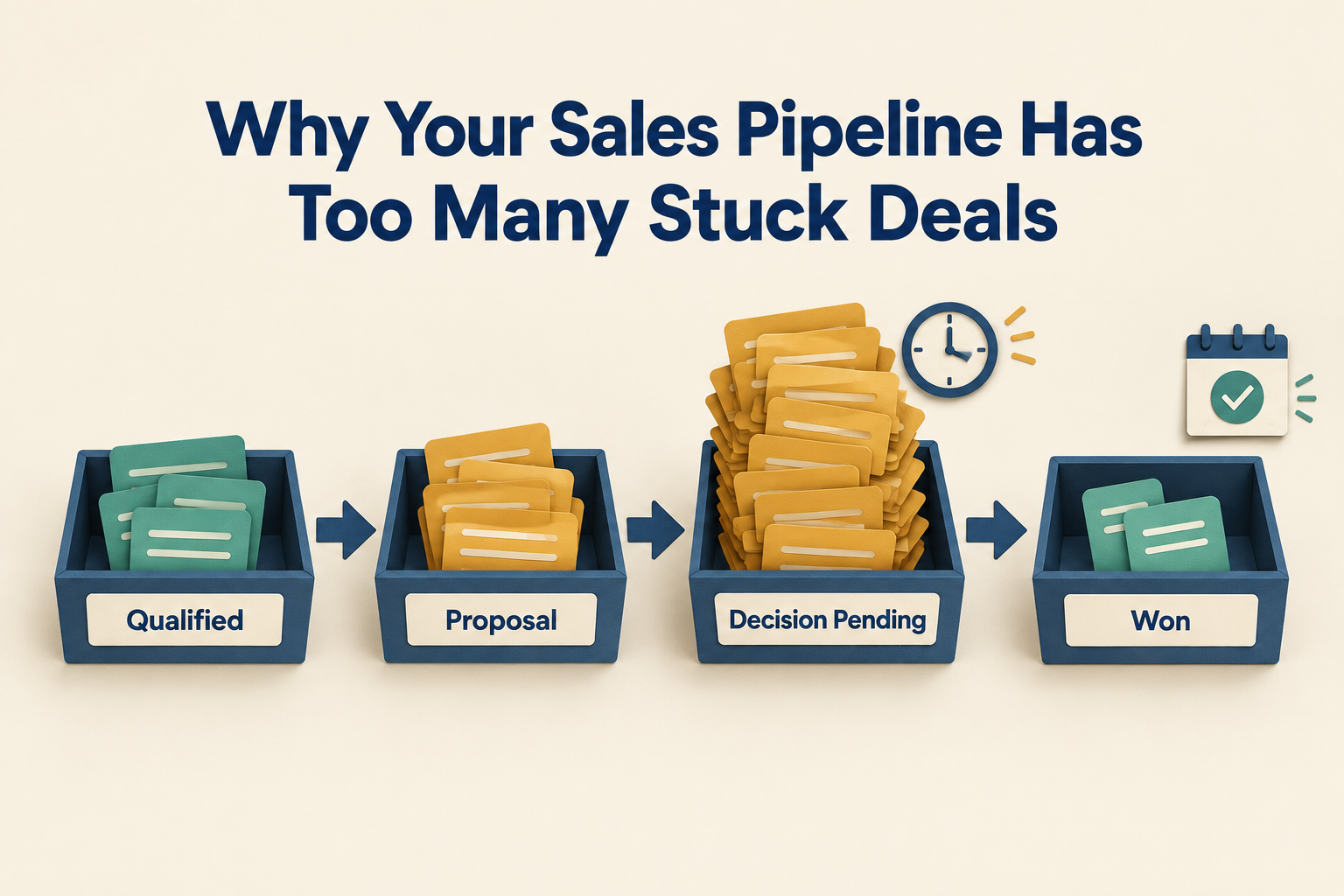
Your pipeline looks busy. Quotes have gone out, prospects have asked questions, and several deals sit in “Decision Pending.”
But when you ask what is likely to close, the answers get vague.
“They’re still thinking.”
“I sent another message.”
“I’ll try calling next week.”
Stuck deals in a sales pipeline often point to missing information, unclear next steps or follow-ups that never address the buyer’s actual concern. Some opportunities also remain open long after the prospect has stopped considering the purchase.
The way forward starts with finding out what each deal is waiting for.

What Makes a Deal “Stuck”?
A deal is stuck when it stops making meaningful progress without a clear reason or an agreed next step.
Age alone does not tell you enough. An interior design project waiting for a confirmed property handover may be progressing normally. A smaller service enquiry with unanswered messages and no decision date may need attention much sooner.
Look for a combination of warning signs:
- The opportunity has stayed in one stage longer than similar deals usually do.
- The buyer has stopped responding.
- Nobody knows what is preventing the decision.
- There is no dated next action.
- The expected closing date keeps moving without new information.
Also separate time in the pipeline, time in the current stage and time since the last meaningful conversation. A month-old opportunity that completed a consultation yesterday needs different attention from one that has been silent for three weeks.
1. Leads Become “Qualified” Before the Basics Are Known
A prospect asks for a brochure or a price. The rep sees interest and moves the opportunity forward.
But the team still does not know whether the requirement fits, whether the budget is realistic or when the buyer plans to act.
The deal later appears stuck at the proposal stage because those questions were never resolved.
How to fix it
Before treating an opportunity as qualified, establish:
- What the person needs.
- Whether your offer is a reasonable fit.
- Their budget or relevant spending constraints.
- Who else is involved in the decision.
- Their intended timeline.
For example, an interior design enquiry saying “Please share your packages” is a starting point. Knowing the property type, possession date, scope of work and approximate budget gives the rep a basis for recommending the next step.
If key information is missing, make gathering it the next action.
2. Your Stages Describe Activity Without Confirming Progress
“Called,” “Message Sent” and “Followed Up” show that the rep did something. They do not explain whether the buyer moved closer to a decision.
Even “Negotiation” can become a holding area for anyone who received a quote.
When stage definitions are loose, a pipeline can look much healthier than it is.
How to fix it
Give each stage a clear entry condition that two reps would apply the same way.
For example:
| Stage | Evidence needed |
|---|---|
| Contacted | A two-way conversation has happened |
| Qualified | Requirement, fit and buying timeline are understood |
| Consultation Booked | The prospect has agreed to a date and time |
| Proposal Sent | A relevant proposal has been delivered |
| Decision Pending | The buyer is reviewing the proposal, with a known decision process |
| Won | Your defined purchase milestone has been completed |
| Metric | What it helps you investigate |
| Time in each stage | Where the buying process slows down |
| Time since meaningful contact | Which conversations may need attention |
| Open deals without a next action | Where follow-up planning is missing |
| Overdue follow-ups | Whether agreed work is being completed |
| Stage-to-stage conversion | Where opportunities stop progressing |
| Lost reasons | Which recurring objections or fit problems need attention |
A proposal can be sent without being read. Keep that distinction visible in the notes and next action.
When building a sales pipeline, choose stages that reflect your actual buying process and define what moves an opportunity between them.
3. There Is No Agreed Next Step
“Let me know what you think” leaves the next move entirely with the prospect.
The buyer may still be interested, but there is no commitment to review the proposal, answer a question or meet again. The rep then waits because they do not want to seem pushy.
How to fix it
End each meaningful conversation by agreeing on a specific next step.
Instead of: I’ll send the estimate. Let me know.
Try: I’ll send the estimate this afternoon. Would Thursday at 11 work for a short call to review the scope and your questions?
Record the action, the owner and the date. If the buyer has not agreed to a meeting, record your intended follow-up accurately without treating it as a confirmed commitment.
Every active opportunity should have a clear answer to: What happens next, and when?
4. Follow-Ups Repeat the Same Question
“Any update?”
“Just checking in.”
“Have you decided?”
These messages ask for progress without helping the buyer make it.
A prospect comparing options, discussing a budget or waiting for internal approval may have no useful answer yet.
How to fix it
Make the follow-up relevant to the last conversation and the unresolved decision.
For example: You mentioned wanting to complete the work before moving in. Is the proposed installation timeline the main concern, or is there something in the scope you’d like to change?
That question gives the buyer something specific to respond to.
A useful follow-up might clarify a price difference, answer a concern, provide a requested example or confirm whether the original timeline still applies.
If consistency is the problem, examine why sales reps stop following up before simply increasing the number of reminders.
5. The Person You Speak With Cannot Make the Decision Alone
Your contact likes the offer. They ask detailed questions and seem ready to move forward.
Then progress stops because a partner, director, finance team or family member still needs to agree.
The opportunity was treated as decision-ready before the decision process was understood.
How to fix it
Ask early and naturally: Who else would you like involved before making a decision?
Then establish what those people need to review.
For a business service, that might mean a joint proposal discussion. For an interior design project, it might mean a consultation with both homeowners.
Help your contact involve the right people. Avoid repeatedly asking them for a decision they cannot make alone.
6. Ownership and Workload Are Unclear
Some stuck deals have a straightforward explanation: nobody is actively managing them.
A lead changes hands without a proper handover. A rep becomes overloaded. Everyone assumes someone else sent the revised quote.
The pipeline still contains an opportunity, but the work behind it has stopped.
How to fix it
Give each open opportunity one accountable owner.
During reassignment, transfer the context as well as the record:
- What has already been discussed?
- What has been promised?
- What is the current blocker?
- What action is due next?
Managers should review overdue work alongside workload. A capable rep with too many active opportunities may need redistribution more than another reminder.
7. Dead and Deferred Opportunities Stay Open
Teams sometimes keep deals open because closing them feels like giving up.
But “no response for months,” “not a fit” and “interested next year” are different situations. Leaving all three in “Decision Pending” hides the opportunities that genuinely need attention.
How to fix it
Give each reviewed deal an honest outcome:
Continue actively when there is a credible buying process and a clear next step. Revisit later when the buyer has given a future timeline. Record the reason and a suitable follow-up date, and distinguish it from near-term business. Close as lost or unqualified when the opportunity has ended or was never a fit. Record what you know rather than guessing the reason.
Respect requests to stop contact. For silent prospects, use a reasonable follow-up policy and a polite closing message rather than indefinite chasing.
A smaller, accurate pipeline makes planning easier.
How to Review Stuck Deals Each Week
A useful pipeline review ends with decisions. It should do more than repeat the notes already on the screen.
Step 1: Find the opportunities that need attention
Start with deals that have overdue actions, no recent meaningful contact, repeated closing-date changes or unusually long stays in a stage.
Use your own sales cycle as the reference. Different stages and industries need different review expectations.
Step 2: Identify the blocker
Ask the owner: What specifically has to happen before this deal can move forward?
“Customer thinking” needs more detail. Is the buyer comparing prices, waiting for approval, uncertain about the scope or no longer prioritising the purchase?
If you do not know, the next action should help establish that.
Step 3: Choose one useful action
Examples include:
- Arrange a discussion with the other decision-maker.
- Clarify one unresolved part of the quote.
- Confirm whether the buying timeline has changed.
- Send the information the buyer requested.
- Close the opportunity if it is no longer active.
Give the action an owner and a date.
Step 4: Look for a repeated problem
One stalled proposal may need a better conversation. Many stalled proposals may indicate weak qualification, unclear pricing or proposals being sent before buyers are ready.
Review the pattern by stage, source and owner before deciding what to change.
How Ridhzo Helps You Review Stuck Deals
Ridhzo brings pipeline status, ownership and follow-up information into the same workflow.
Its pipeline board displays leads by stage, with cards showing details including the owner, deal value and next follow-up. You can customise statuses in Settings → General → Statuses to match your sales process.
Status changes are recorded with who made the change and when. Ridhzo’s Insights also includes funnel velocity, stuck-deal views with risk levels and pipeline aging, helping managers identify where opportunities need closer review.
For day-to-day action, My Dashboard shows a rep’s follow-ups and overdue tasks. Stage-specific AI playbooks provide qualifying questions, objection-handling guidance and next-milestone criteria that can help reps prepare for the next conversation.
A practical setup is to define clear stages, assign an owner, record the next follow-up and review aging opportunities regularly. Use the information to investigate the blocker before deciding whether to advance, revisit or close a deal.
Metrics That Help You Spot Pipeline Problems
Keep your review focused on measures that lead to action:
| Metric | What it helps you investigate Time in each stage | Where the buying process slows down | | Time since meaningful contact | Which conversations may need attention | | Open deals without a next action | Where follow-up planning is missing | | Overdue follow-ups | Whether agreed work is being completed | | Stage-to-stage conversion | Where opportunities stop progressing | | Lost reasons | Which recurring objections or fit problems need attention |
Treat these as questions to investigate. An aging deal may still be viable, and a high activity count does not necessarily mean the buyer is engaged.
FAQs
How long should a deal stay in one pipeline stage?
There is no single limit that fits every business. Compare it with similar opportunities and the expected buying process. A delay deserves attention when it exceeds normal expectations without a clear explanation or an agreed next step.
Should I offer a discount to move a stuck deal forward?
First confirm that price is the actual blocker. A discount will not resolve missing approval, unclear requirements or an unsuitable timeline. Discuss the concern before changing the offer.
Should I move a stuck deal back to an earlier stage?
Yes, if that stage more accurately reflects what you know. An opportunity marked qualified may need further qualification after the scope or budget changes. Moving it backward should correct the record, not reset its apparent age.
Can a CRM prevent every deal from getting stuck?
No. Buyers can change priorities, lose budget or choose another supplier. A CRM helps your team keep track of ownership, conversations and next actions so delays are easier to notice and address.
Give Every Open Deal a Reason to Stay Open
Choose a manageable set of aging opportunities and review them this week. For each one, identify the blocker and record a dated next action—or give it a more accurate outcome.
If your team needs a shared place to manage that process, explore Ridhzo’s pipeline board, follow-ups and Insights. Start with a simple standard: every open deal should have an owner, an accurate stage and a clear reason for what happens next.