
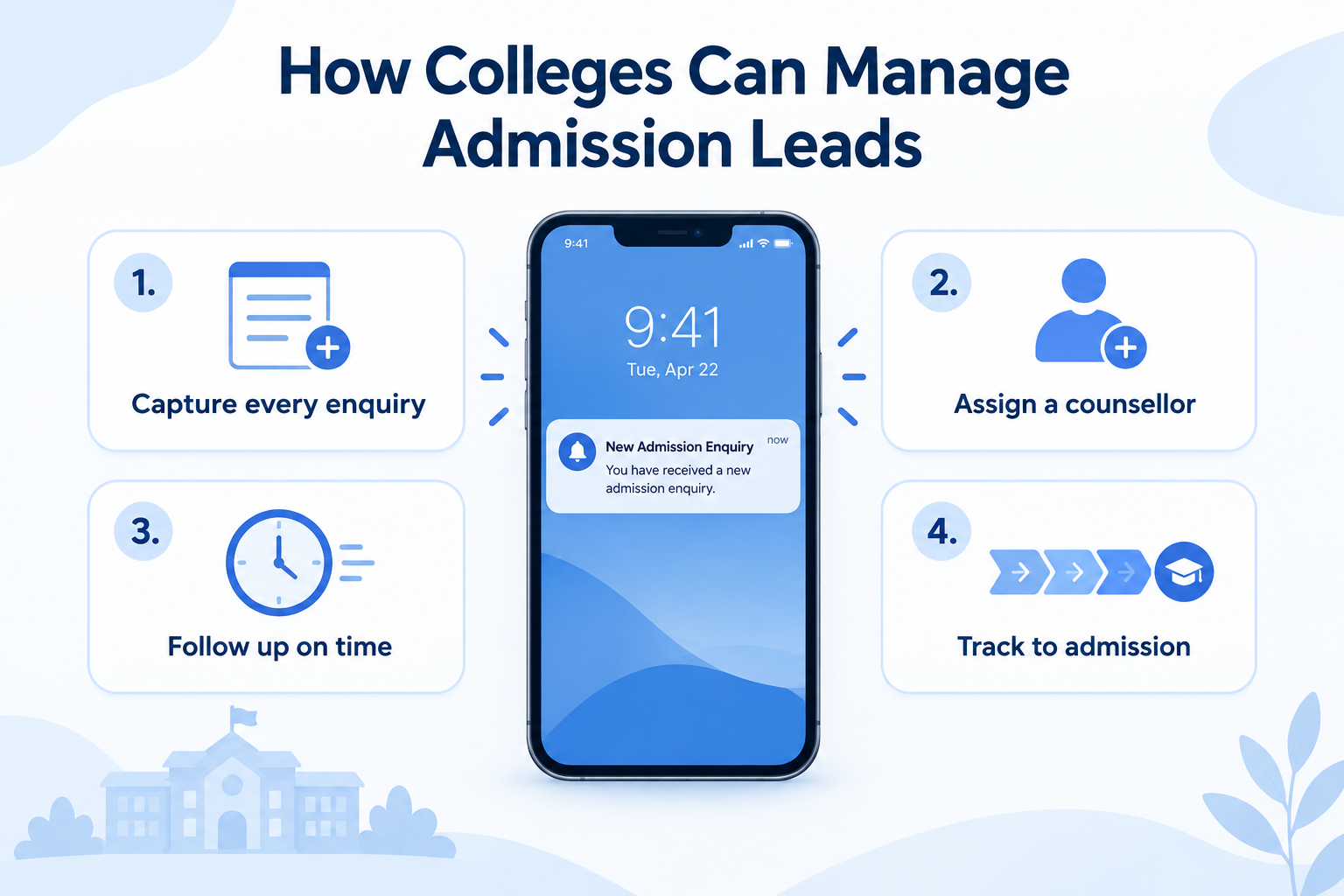
Admissions season at a college looks the same everywhere: a burst of Google and Instagram enquiries, walk-ins, education-fair contacts and calls to a front desk that also handles everything else. The enquiries arrive in weeks, the intake deadline is fixed, and somewhere in between, a large share of interested students never hear back from anyone.
The problem is rarely effort. It’s that the enquiries live in five places — an inbox, a spreadsheet, three counsellors’ personal WhatsApp chats and a stack of fair forms — and nobody can see which student is waiting for what. Here’s how to fix that, step by step.
1. Get every enquiry into one place first
You cannot manage what you can’t see. List every channel that produces admission enquiries:
- Google lead form ads (search campaigns for course and admission keywords)
- Facebook and Instagram lead ads
- The enquiry form on your website
- Walk-ins and calls to the front office
- Education fairs and school visits
- QR codes on hoardings, brochures and campus signage
Each one needs a capture route into a single system. Ad platforms support direct integrations — for example, Ridhzo connects Facebook and Instagram Lead Ads with a one-click login and brings Google Lead Form leads in through a webhook URL, with campaign and form attribution preserved. Website forms can point at a webhook or a hosted form, and fair contacts can be imported via CSV. Missed calls to the counsellors’ Android phones can even be captured as leads.
The test: submit one enquiry from each channel and confirm it appears in the same list, with its source recorded.
2. Give every lead an owner immediately
An enquiry with no owner is an enquiry nobody answers. Assignment should happen at the moment of capture, not at the morning meeting.
Colleges usually assign by:
- Round-robin across all counsellors, for fairness
- Teams, so a Hindi-speaking parent reaches a Hindi-speaking counsellor, or a science-stream enquiry reaches the science counselling team
- Capacity, so the counsellor with the most open follow-ups doesn’t receive the next hot lead
Ridhzo supports all three, and alerts the assigned counsellor’s phone the second a lead arrives — the difference between a callback in four minutes and one the next afternoon is often just who knew the lead existed.
3. Record what counsellors learn on the lead itself
During counselling, staff learn the details that decide the outcome: course interest, qualification, city, intake month, budget, parent’s phone number. If those live only in a notebook or a chat thread, the next person to contact the student starts from zero — and when a counsellor resigns mid-season, the knowledge walks out with them.
Use custom fields on each lead record (course, qualification, city, intake, parent phone) and require notes after every conversation. An activity timeline on the lead — every call, message and visit — means any colleague can pick up the thread.
4. Track each student through an admission pipeline
A pipeline is just the journey, made visible. A typical college version:
New → Contacted → Qualified → Campus Visit Scheduled → Visit Done → Application Started → Admitted / Lost
Each lead sits in exactly one stage, so at any moment you can count how many enquiries are waiting for first contact, how many visits are booked this week, and how many applications have started but stalled — which is where the recoverable enrolments usually hide.
5. Make follow-ups automatic and unavoidable
Admissions run on follow-ups: fee details, scholarship options, document deadlines, one final reminder before the intake closes. A practical rhythm:
- Day 0: first call or WhatsApp within minutes of enquiry
- Day 1–2: course details and brochure
- Day 4–5: scholarship and fee information
- Final week: deadline reminder, then a last polite check-in
Two mechanisms keep this from depending on memory. Reminders — every follow-up has a date and time, alerts the counsellor’s phone, and overdue items escalate to the manager. Sequences — multi-step WhatsApp/email campaigns that send course info, then scholarship info, then the fee deadline, and stop the moment the student replies. Ridhzo supports both, and answered calls on synced Android phones automatically close their pending callbacks, so the task list stays honest.
An automation can tie it together, for example: WHEN a new lead arrives → IF the form is “B.Tech Admission” → THEN assign to the engineering counselling team and schedule a follow-up for the next working morning.
6. Let parents book their own campus visits
Campus visits convert — but scheduling them by phone tag wastes both sides’ time. A public booking page where parents choose a slot themselves removes the back-and-forth, and automatic confirmations with your campus location and a map link reduce no-shows. Ridhzo’s booking page does exactly this, and each booked slot creates the meeting on the counsellor’s calendar.
7. Report on enrolments, not enquiries
The number that matters at the end of the season is not form fills — it’s which campaigns produced admissions. With source attribution on every lead, you can compare Google vs. Meta vs. fairs on actual enrolments, and stop spending on channels that generate enquiries but not students.
A short weekly review is enough:
- New leads without an owner
- Enquiries still awaiting first response
- Overdue follow-ups
- Enrolments by source, and call answer rates by counsellor

Common mistakes to avoid
- Treating an auto-reply as a response. A template acknowledging the enquiry doesn’t answer “what’s the fee structure?” A counsellor still makes first personal contact.
- Keeping enquiries in personal WhatsApp. When a counsellor leaves, the conversations leave with them.
- Importing old fair lists as “new” leads. Backfilled lists shouldn’t mix into current response-time metrics — measure from when the enquiry actually arrived.
- Stopping all contact the day the deadline passes. A win-back sequence for silent leads costs nothing and recovers students for the next intake.
Getting started
Pick one source and one intake cycle: connect your highest-volume lead form, set up assignment across the counselling team, and run a test enquiry end to end — submit it, confirm the right counsellor is alerted, watch the call log and the follow-up appear. Then connect the rest.
Ridhzo is a mobile-first lead CRM that supports this whole workflow — lead capture from ads and forms, automatic counsellor assignment, instant mobile alerts, Android call sync, follow-up reminders, sequences, booking pages and source-level reporting. The Free plan (one source, one sequence, full mobile and call-sync features) is enough to run the first test.
See how a college admission pipeline works in practice — try Ridhzo free.
FAQs
We get only 30–40 enquiries a week. Is a system worth it? If enquiries arrive through more than one channel and more than one counsellor handles them, a shared system pays off immediately — even at low volume. Fixed intakes make lost follow-ups unusually expensive in education.
Can we keep using WhatsApp for counselling? Yes. One-tap WhatsApp opens a chat straight from the lead record, so conversations stay in WhatsApp but the history and follow-up live on the lead. Optional Business API mode handles automated sequences.
Do we need this if we already have an ERP or student management system? They solve different problems. An ERP manages enrolled students — fees, attendance, academics. A lead CRM manages the pipeline before admission: capture, contact, counselling and conversion. Most colleges need both.