
Insurance is a business built on two clocks: the enquiry that needs a call within minutes, and the renewal that needs a call weeks before it lapses. Most agents run both from memory, a diary, and phone full of WhatsApp chats — and lose business in the gaps.
This guide explains what an insurance CRM actually needs to do, how to evaluate options, and a practical setup for solo agents and small agency teams.

What Lead Management Looks Like in Insurance
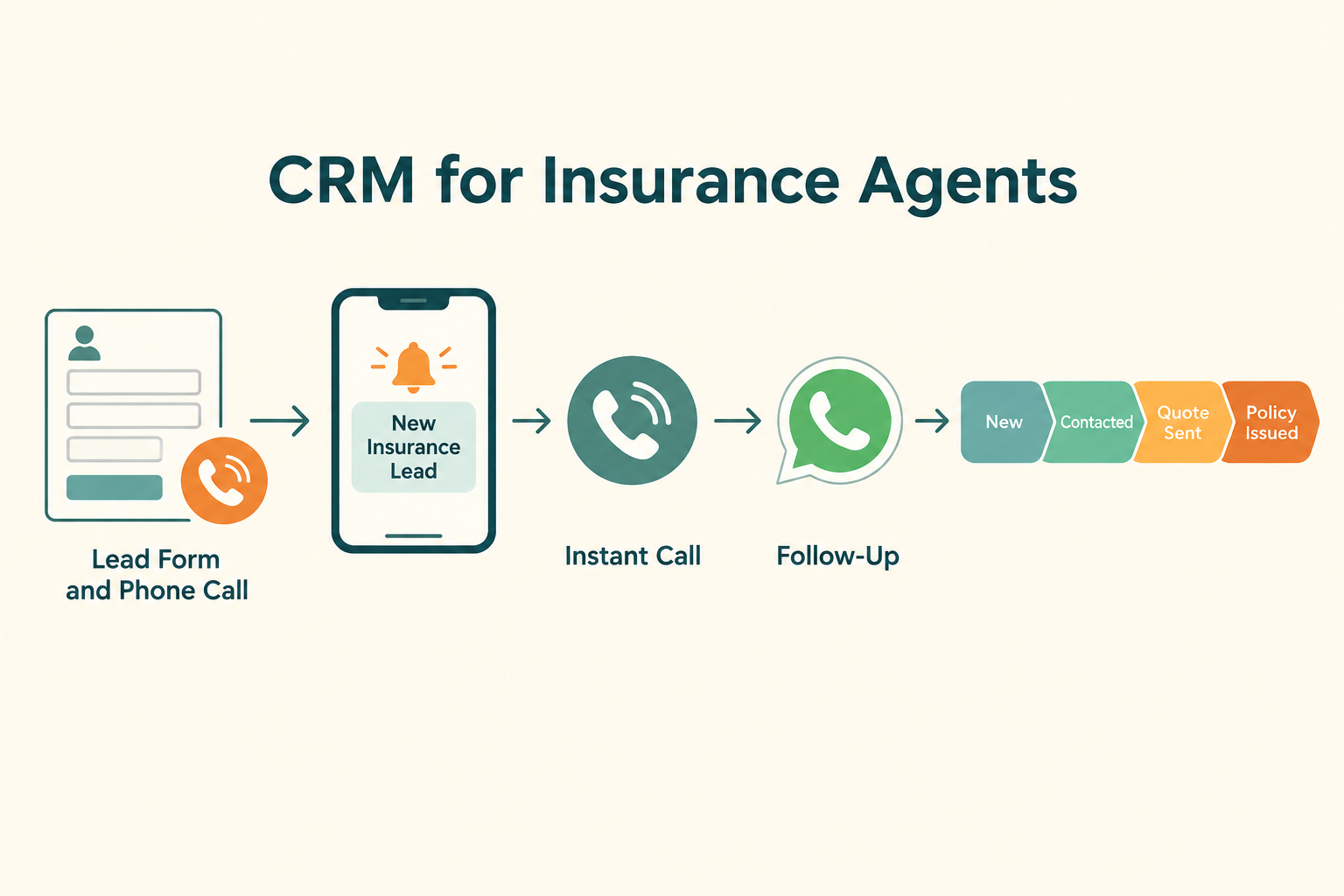
A prospective policyholder moves through a familiar journey:
- Enquiry: A Facebook or Instagram ad form, a Google lead form, your website, a referral, or your hosted form link shared in a WhatsApp status or Instagram bio.
- First contact: You call or message within minutes, while interest is high.
- Qualification: Policy type, sum assured, age, budget, health disclosures — captured on the lead record, not in your head.
- Documents: KYC and proposal forms collected and tracked against the lead.
- Follow-up: Quote explanations, comparisons, premium confirmations — often multiple touches over days or weeks.
- Sale or drop-off: Policy issued, or silence that needs a polite last attempt.
Then a second clock starts: the renewal date. Every customer you issue today is a follow-up due in a year. A CRM built for insurance keeps both clocks running without you remembering either.
What to Compare When Choosing
Lead capture depth. Does it connect natively to Meta Lead Ads (Facebook and Instagram) and Google Lead Form Ads, with leads arriving within seconds? Can you import your existing client base by CSV with deduplication? Can you use a hosted form link as a capture point on WhatsApp and social profiles? Mobile-first, not mobile-available. Agents work from their phones — in cars, at client homes, at branch offices. Test whether you can open a lead, call, message on WhatsApp, add a note and set a follow-up one-handed. A stripped-down companion app to desktop software will not get used. Automatic call tracking. Agents make dozens of calls a day. If logging depends on typing notes, the history decays within a week. Look for automatic syncing of incoming, outgoing and missed calls with talk duration, and note that automatic sync is Android-only in some products, including Ridhzo. Caller ID that shows the lead’s name when a client calls back is a strong signal the tool is built for phone-led sales. WhatsApp built in. Most clients converse on WhatsApp. One-tap personal WhatsApp from the lead card, and — if you run volume — automated messaging through the official WhatsApp Business API (fees billed by Meta/your provider, not the CRM). Custom fields for insurance. You need Policy Type, Sum Assured, Renewal Date and a Documents Received checkbox as actual fields you can filter and report on — not free-text notes. Dated follow-ups with renewal support. Reminders that appear as phone notifications, answered calls that auto-complete the pending callback, and overdue escalation to a manager or team leader. Drip sequences. New insurance leads typically need a multi-day nurture: quote introduction → policy comparison → consultation offer → final check-in. Look for sequences that run themselves and stop the moment the lead replies. Automation without code. Simple WHEN → IF → THEN rules, for example: new lead → assign round-robin → WhatsApp welcome → follow-up in 1 hour. Or missed call → instant “sorry we missed your call” WhatsApp → high-priority callback task. Reporting. First-response time, call answer rates, conversion by stage, and — critically — which sources produce issued policies, not just enquiries. Pricing model. Many CRMs charge per user per month, which gets expensive as your agency grows. Check what the free tier includes before committing.
How Ridhzo Supports Insurance Workflows
Ridhzo is a mobile-first lead CRM, and insurance, loans and financial advisors are a documented use case. Documented support includes:
- Sources: Facebook/Instagram Lead Ads, Google Lead Form Ads, hosted forms (useful for a link in your WhatsApp status or Instagram bio), website webhooks, CSV import of your existing contacts, and Android call sync.
- Custom fields: Policy Type, Sum Assured, Renewal Date (date) and Documents Received (checkbox), with follow-ups scheduled against renewal dates and attachments for KYC documents.
- Automatic call sync and Caller ID: calls logged automatically with talk duration; answered calls auto-complete pending follow-ups; incoming calls from active leads show the client’s name before you answer.
- WhatsApp: one-tap personal WhatsApp on every plan; automated WhatsApp through a supported WhatsApp Business API connection.
- Automations: plain-language WHEN → IF → THEN rules. A documented insurance example: every new lead automatically gets a follow-up for tomorrow 10 AM, so none are forgotten. Missed Call Recovery is a ready-made template.
- Sequences: multi-step WhatsApp/email nurture, including a documented insurance cadence — Day 0 quote introduction, Day 2 policy comparison guide with attachment, Day 5 consultation offer with booking link, Day 8 final check-in.
- AI assistance: pre-call briefs before you dial, 1-click field updates from call notes, and AI drafts in Hindi/Hinglish for quick, personal replies.
- Meetings and booking: a public booking page where leads book a consultation slot themselves within your business hours, with confirmations and automatic reminders.
- Pricing: Free plan (1 user, 300 leads), Starter at ₹249/month (3 users, 5,000 leads), Unlimited at ₹449/month (unlimited users and leads). WhatsApp Business API conversation fees are billed by Meta/your provider. A solo insurance advisor fits on the Free or Starter plan with personal WhatsApp mode.
A Practical Setup for a Solo Agent
- Import your base: CSV-import your existing client and prospect list with deduplication.
- Add custom fields: Policy Type, Sum Assured, Renewal Date, Documents Received.
- Set renewal follow-ups: schedule a follow-up against each renewal date so it surfaces as a notification weeks before it lapses.
- Put your form link in your WhatsApp status and Instagram bio: every click becomes a captured lead.
- Build one automation: new lead → follow-up tomorrow 10 AM.
- Run one sequence: the 7-day insurance nurture — Day 0 quote intro, Day 2 comparison guide, Day 5 consultation offer, Day 8 final check-in.
- Review weekly: check first-response time and which sources produce issued policies.
FAQ
Is Ridhzo an insurance-specific CRM? No. Ridhzo is a mobile-first lead CRM, and insurance is a documented use case with documented custom fields, sequences and automations for insurance workflows. It does not handle policy administration, underwriting or claims — that belongs to your insurer’s systems. Ridhzo covers the front of the funnel: enquiry to issued policy, plus renewal follow-ups.
Can I track policy renewals? Yes. Renewal Date is a documented custom field, and you can schedule follow-ups against it so renewals surface as dated reminders.
Does it log my calls automatically? On Android, yes — incoming, outgoing and missed calls are synced automatically with talk duration, and matched to leads. Answered calls auto-complete scheduled follow-ups.
How much does it cost? Free forever plan for 1 user with 300 leads; Starter at ₹249/month for 3 users and 5,000 leads; Unlimited at ₹449/month for unlimited users and leads. GST extra. WhatsApp Business API conversation fees are billed by Meta/your provider.