
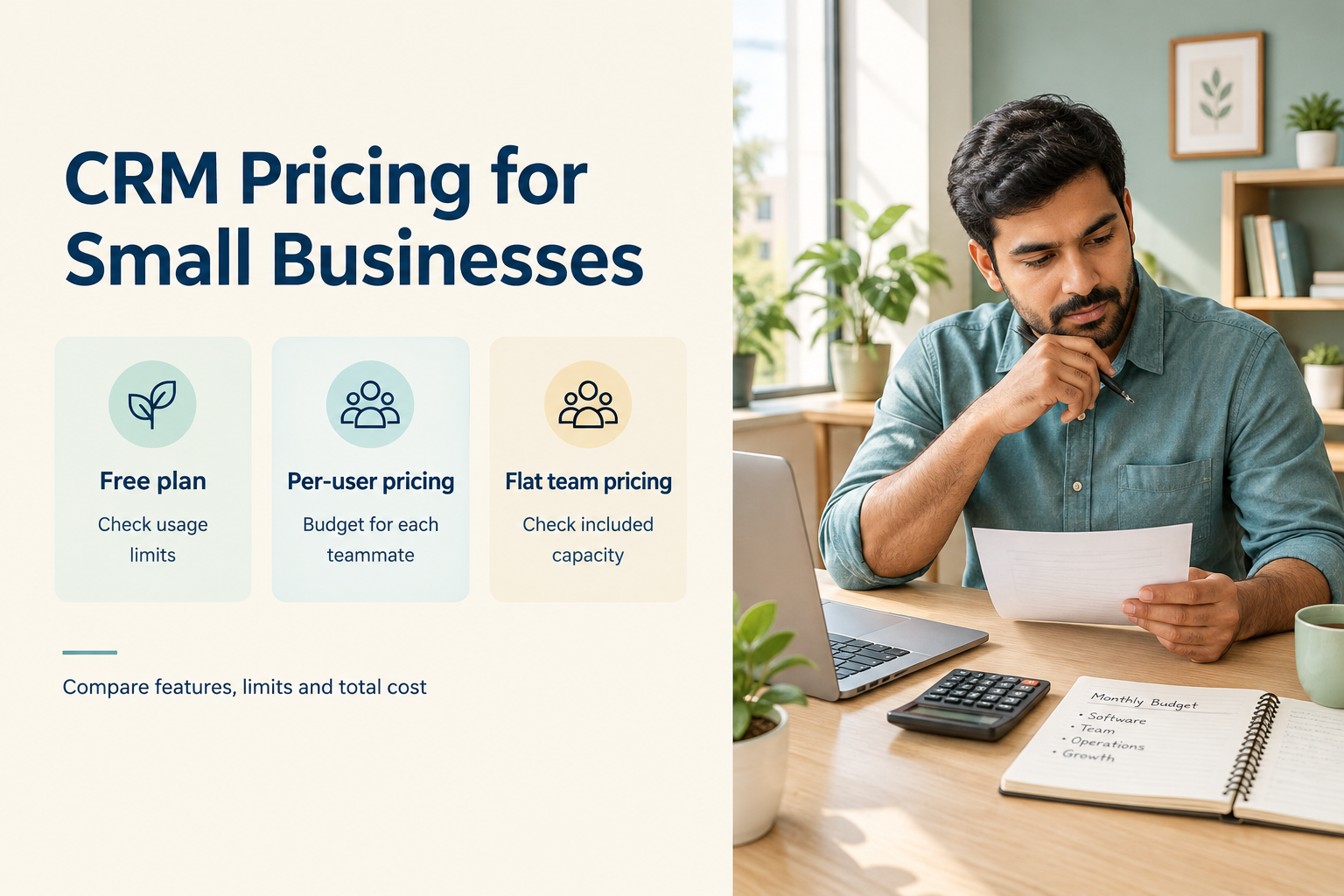
A CRM’s price tag rarely tells the whole story. Two tools that “cost the same” can end up hundreds of rupees apart once you add a third teammate, hit a lead limit, or get charged 18% GST at checkout.
For a small business, the question isn’t just “how much does a CRM cost?” — it’s “how does this vendor charge, and what will my team actually pay as we grow?”
This guide breaks down the pricing models you’ll encounter, the costs that hide in the fine print, and how to pick a plan that won’t punish you for growing.
The Three Ways CRMs Charge
1. Per-user pricing
Most established CRMs charge per seat: each teammate who logs in costs a monthly fee — often in the range of ₹1,000–₹5,000 per user per month on bigger platforms. The math looks harmless for one person and gets expensive fast: a 5-rep team at ₹2,000 per user is ₹10,000 every month, before GST.
Who it suits: large organisations with defined roles and complex workflows. For a growing small business, per-user pricing turns every new hire into a billing decision.
2. Flat team pricing
Some CRMs charge by plan, not headcount. Ridhzo, for example, prices its top plan at ₹449/month for unlimited users and leads — so adding your fourth rep costs exactly nothing. Starter (₹249/month) covers 3 users.
Who it suits: any team that expects to grow. Flat pricing means the CRM scales with you, not against you.
3. Free plans with real limits
A free plan isn’t a demo if it keeps your data. The important questions are: what are the limits, and what happens when you hit them?
A good free plan behaves like Ridhzo’s: 1 user, 300 leads, 1 lead source, 2 automations — and when you reach a limit, you see a clear message and an upgrade button. Nothing is deleted, and if you ever downgrade, your older automations keep running while only the excess is paused.

What Drives the Price Up
Watch for these cost drivers before you commit:
- Feature gating — automation, AI, and integrations locked behind top tiers.
- Add-ons — WhatsApp Business API conversation fees are billed by Meta or your provider, separate from the CRM. (Personal one-tap WhatsApp, as in Ridhzo, is free.)
- GST — most Indian CRM prices are quoted exclusive of 18% GST, added at invoicing.
- Setup fees and contracts — many small-business CRMs have neither; ask before you sign.
- Inactive seats — some vendors charge for pending invites or past employees. Ridhzo, for instance, counts seats only for active users, so you never pay for ex-staff.
Reading a Plan Table the Right Way
When comparing plans, check these rows specifically:
The last row is the quiet one that matters most. A well-designed CRM puts its core features — lead inbox, pipeline, follow-ups, reminders, mobile app, push alerts — on every plan, including Free, and lets plans differ only by volume. That’s how Ridhzo structures its plans, and it’s a good pattern to hold any vendor against.
A Concrete Example: Ridhzo’s Plan Table
To make this real, here’s one fully documented pricing structure (all prices exclusive of 18% GST):
Every plan includes the lead inbox, pipeline, follow-ups, one-tap WhatsApp, templates, dashboards, the mobile app, Android call sync, and push alerts. New workspaces start with a 14-day Starter trial — no card required — and move to Free automatically if you don’t subscribe, with nothing deleted.
How to Choose Your Plan
- Solo, testing, under 300 leads: start on a free plan and see if the habit sticks.
- 2–3 people running ads: a starter-level plan — enough sources and automations to run real capture and follow-up. At Ridhzo’s pricing, that’s about ₹8/day for the team.
- 4+ people or high lead volume: the unlimited tier. This is where flat pricing shines — the bill stays fixed no matter how many reps you add.
Red Flags in Small-Business CRM Pricing
- Prices that only make sense “per user” for a team you plan to grow.
- Trials that delete your data when they end.
- No clear answer on what happens at plan limits.
- GST, setup fees, or API charges that only appear at checkout.
- Downgrades that break your running automations or sequences.
If a vendor can answer all five plainly, you’re probably in good hands.
FAQs
Is a free CRM plan actually usable for a business? Yes, if the limits match your volume. Ridhzo’s Free plan handles 1 user, 300 leads, 1 source, 2 automations, 1 sequence and 15 AI credits a month — enough to test the entire workflow before paying anything.
What’s cheaper: per-user or flat pricing? For growing teams, almost always flat. Per-user pricing scales linearly with headcount; a flat ₹449/month for unlimited users beats even ₹500/user pricing the moment you have two reps.
Are CRM prices in India inclusive of GST? Usually not — 18% GST is typically added at invoicing. Good CRMs generate proper GST-compliant invoices with the CGST/SGST/IGST breakdown so you can claim input credit.
Do I pay extra for WhatsApp messaging? Official WhatsApp Business API conversation fees are billed by Meta or your WhatsApp provider, separate from your CRM. Personal one-tap WhatsApp (Ridhzo’s default) is free.
Can I switch plans or cancel later? With a fairly priced CRM, yes — monthly, any time, no contract. Your data should stay with you even after a downgrade.