
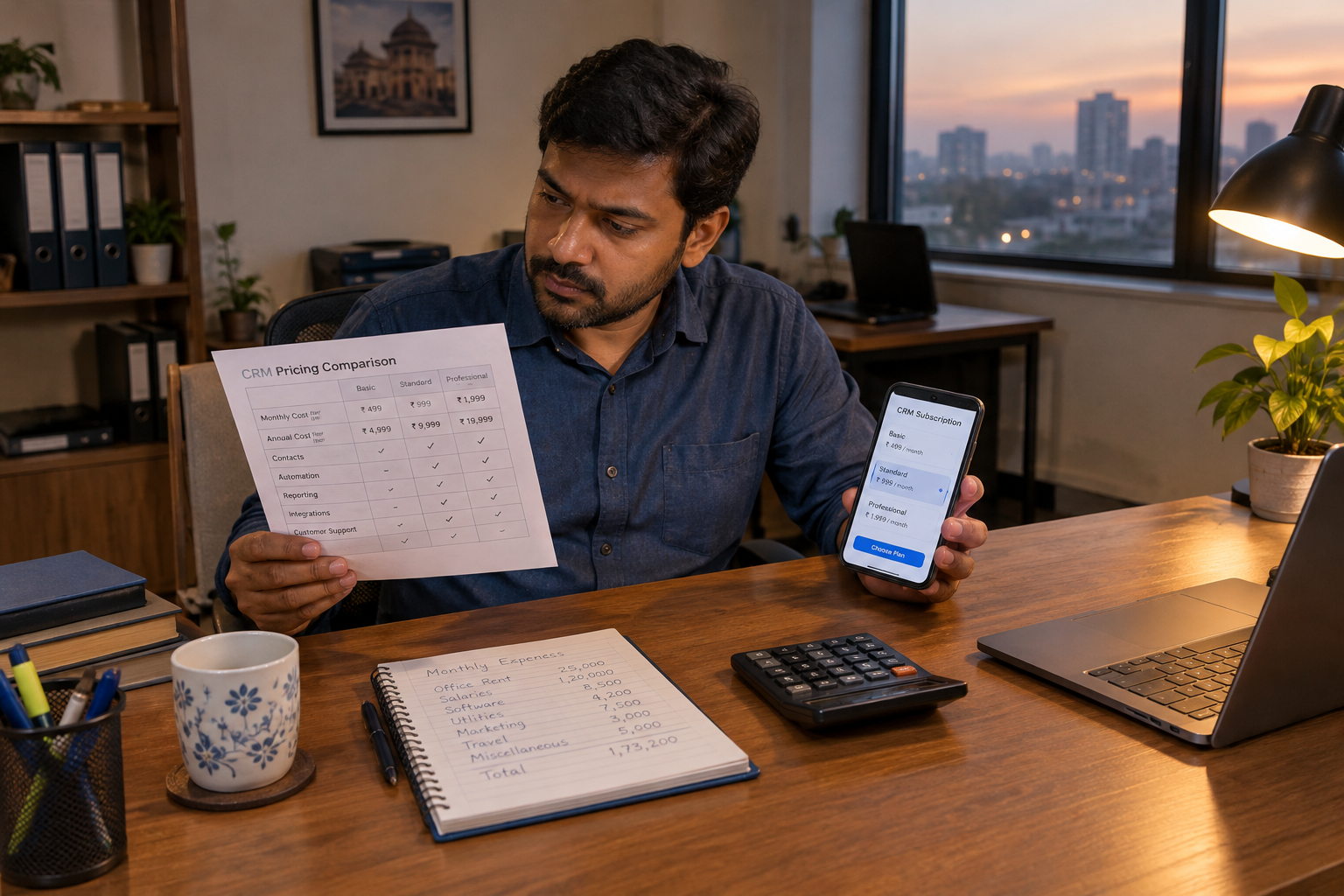
If you’re a small business owner in India shopping for a CRM, the first question is almost always price. And the honest answer is frustrating: “it depends.” A CRM can cost nothing — or ₹1,000–₹5,000 per user per month for the bigger, per-user-priced platforms.
This guide breaks down how CRM pricing actually works in India, what drives the cost up or down, and what a small business should realistically budget.
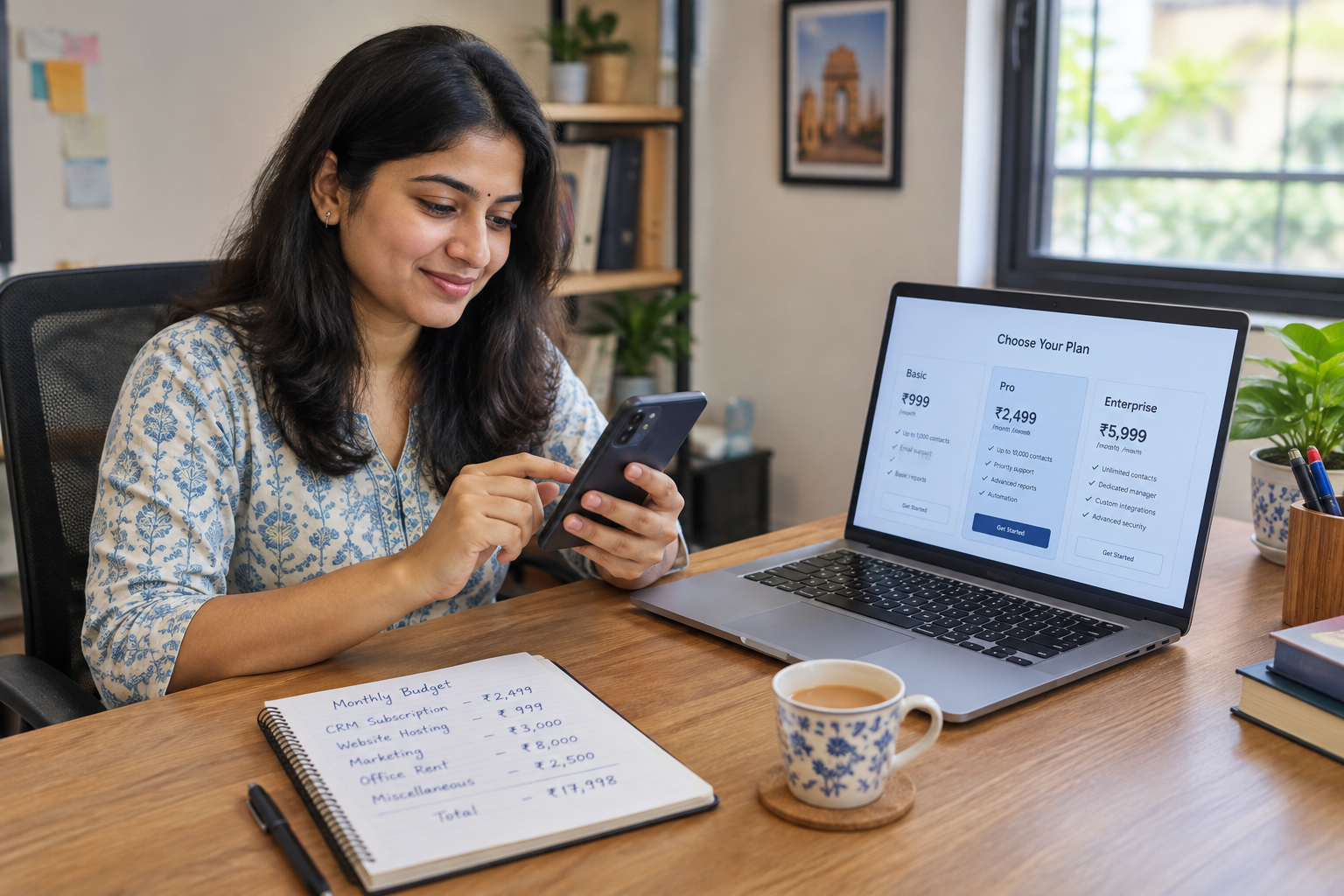
The Short Answer
There are three broad price bands in the Indian market:
- Free CRMs: Free-forever plans exist (Ridhzo, for example, has one). They’re real products with limits on volume — users, leads, or features — rather than expiring trials.
- Affordable small-business CRMs: Roughly ₹200–₹500 per month for a team plan. You get lead capture, follow-ups, and reporting without per-user pricing.
- Enterprise-style CRMs: Typically ₹1,000–₹5,000 per user per month. The price scales with headcount, so a 10-person team can easily spend ₹1 lakh+ per year.
The band you need depends less on your budget and more on what your team actually does with leads.
How CRM Pricing Models Work in India
1. Per-user pricing
Most established CRMs charge per seat. Ten users means ten times the price. This model suits large orgs with complex roles — but for a growing sales team, every new hire becomes a billing decision.
2. Flat team pricing
Some CRMs price by plan, not by headcount. Ridhzo, for example, charges ₹449/month for unlimited users and leads on its top plan — a deliberately small-business-friendly structure where adding a rep doesn’t change your bill. Seats are only counted for active users and pending invites, so you never pay for deactivated team members.
3. Free plans with limits
Free-forever plans are worth taking seriously, not just as demos. The question to ask: what are the limits, and what happens when you hit them? A good free plan keeps your data — when the trial ends, the workspace moves to Free automatically and nothing is deleted.
4. Monthly vs yearly
Most Indian CRMs offer both. Yearly plans usually come with a discount — Ridhzo’s yearly plans work out to 10× the monthly price (2 months free). Start monthly, switch to yearly once the tool has proven itself.
What Drives CRM Cost Up
- Per-user billing — the biggest multiplier for growing teams.
- Feature gating — automation, AI, and integrations locked behind top tiers.
- Add-ons — WhatsApp Business API conversation fees (billed directly by Meta or your provider, separate from the CRM), SMS credits, onboarding fees.
- GST — Indian CRM pricing is usually quoted exclusive of 18% GST, so add it to your real budget.
- Enterprise features you won’t use — territory management, complex admin, and workflows you’re paying for but don’t need.
- Setup fees and contracts — some vendors charge both. Others (like Ridhzo) charge neither: no setup fee, no contract, cancel any time.
What to Check Before Paying
- Is there a free plan or trial? Ridhzo gives every new workspace a 14-day Starter trial — no card required — plus a free-forever plan.
- Is the quoted price per user or per team?
- Is GST included? Most Indian CRMs add 18% on top. Ask for GST-compliant invoices with a CGST/SGST/IGST breakdown if you’re claiming input credit.
- What happens at the limits? Look for plans where nothing gets deleted and, if you downgrade, your oldest automations and sequences keep running while the rest pause — not a hard shutoff.
- Payment methods — UPI, cards, and net banking through a local gateway (Ridhzo uses Razorpay) are easier than international cards.
A Real Example: Ridhzo’s Pricing in India
To make this concrete, here’s one fully documented example (prices exclusive of 18% GST):
Core features — lead inbox, lead scores, pipeline, follow-ups and reminders, one-tap WhatsApp, templates, dashboards, the mobile app, Android call sync, offline sync and push alerts — are available on every plan, including Free. Plans differ on volume limits and form branding (the “Powered by Ridhzo” badge is removed on paid plans).
A useful frame from Ridhzo’s own value comparison: ₹249/month works out to about ₹8 a day for a 3-person team — and one converted lead usually pays for a full year.
What a Small Business Should Actually Budget
If you’re a solo agent or a team under 10 people doing lead-driven sales — real estate, insurance, education, clinics, gyms, agencies — a realistic budget is ₹0–₹500 per month total, not per user.
You only need the per-user, enterprise-priced tier when you have complex multi-department workflows. If your problem is “leads come in from ads, forms, calls and WhatsApp, and we need to respond fast and follow up” — that’s a small-business CRM problem, and it’s priced like one.
FAQs
Is there a truly free CRM in India? Yes. Ridhzo has a free-forever plan: 1 user, 300 leads, 1 lead source, 2 automations, 1 sequence, and 15 AI credits per month. It’s a real plan, not a trial — your data stays even if you never upgrade.
Is CRM pricing in India inclusive of GST? Usually not. Most Indian CRMs quote prices exclusive of 18% GST, added at invoicing. Ask for the GSTIN, CGST/SGST/IGST breakdown and HSN/SAC codes on your invoice if you’re claiming input credit.
Per-user or flat pricing — which is better? If your team will grow, flat pricing protects you. Per-user pricing suits large orgs; for small teams it makes every hire a cost decision.
Do WhatsApp costs come on top of CRM pricing? Official WhatsApp Business API conversation fees are billed directly by Meta or your provider — separate from your CRM subscription. Personal one-tap WhatsApp use (as in Ridhzo) is free.
Do I lose my data if I downgrade? With Ridhzo, no. Leads, history and settings stay. If you have more automations or sequences than the new plan allows, the oldest keep running and the rest pause until you upgrade again.
How much should a small business spend on a CRM? For most small Indian businesses doing lead-based sales: ₹0–₹500 per month total covers it — enough for capture, alerts, follow-ups, call tracking and reporting.