
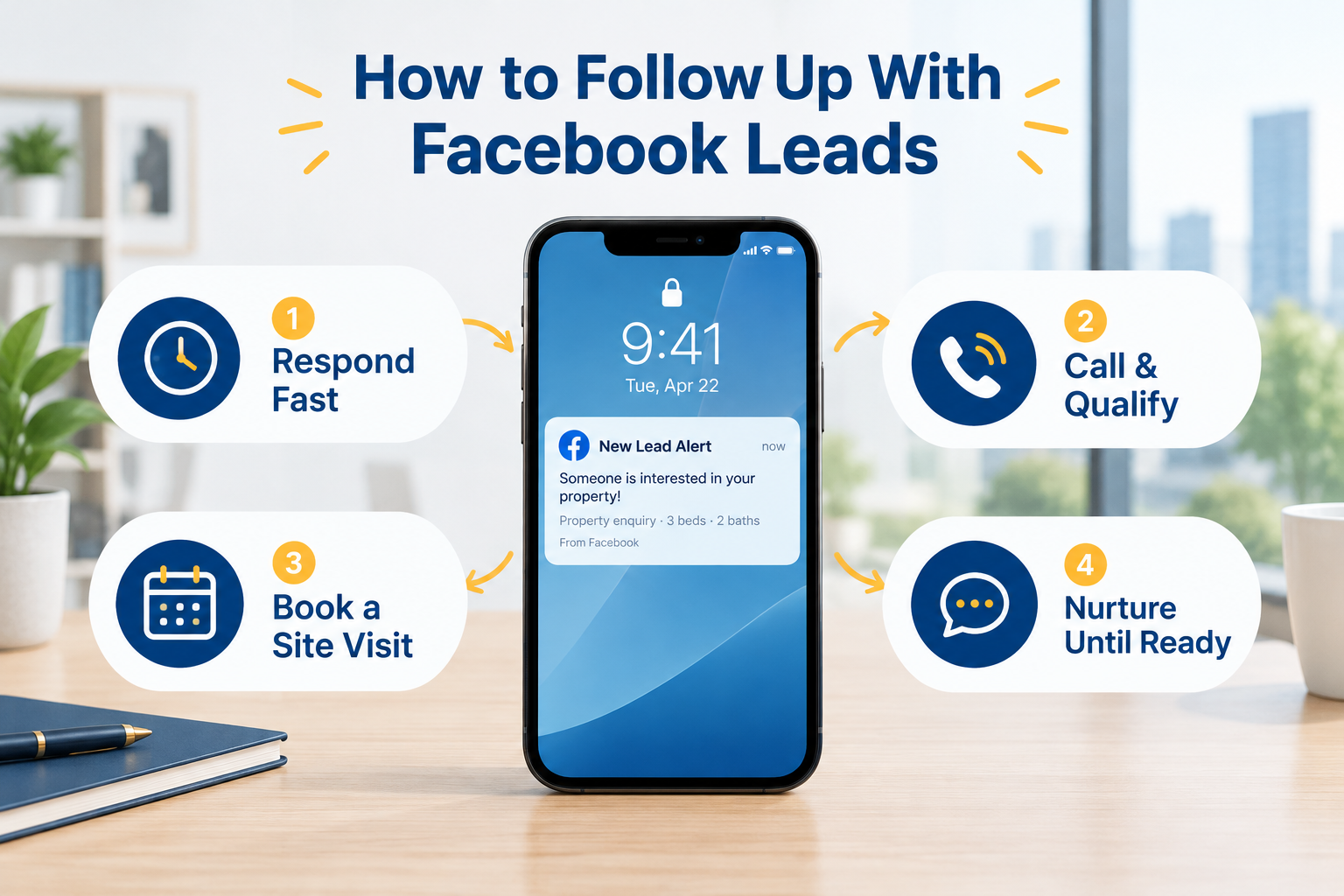
A Facebook lead ad delivers a buyer’s details in seconds. What happens in the next hour decides whether that enquiry ever becomes a site visit.
Real estate is a considered purchase. Buyers compare projects for weeks and forget who they spoke to. Yet the first hours still matter enormously: an enquiry contacted within minutes feels attended to, while one contacted the next day often assumes the project is already sold or the team isn’t serious.
This guide covers the follow-up rhythm, scripts, and handoffs real estate teams should use for Facebook leads — from first call to booking a site visit to nurturing buyers who aren’t ready yet.
1. Respond Within Minutes, Not Hours
A Facebook lead is not a buyer yet — it’s a person who tapped a form while scrolling. Interest peaks at the moment of submission and decays fast.
The first call should happen within 5–15 minutes of the lead arriving during working hours. Two reasons:
- The buyer is often still holding their phone.
- You catch them before another project’s ad convinces them to enquire elsewhere.
An automated WhatsApp acknowledgement within the first minute (“Thanks for your interest in Skyline Residences — Ravi will call you shortly”) buys you that window. But don’t count it as contact: someone still has to make the first personal call.
What speed requires
- Leads arrive directly in your CRM — not as CSV downloads.
- Every lead has an assigned owner the moment it lands.
- The assigned agent gets a push alert with the lead’s details and form answers (budget, configuration, preferred location).
- Out-of-hours enquiries get an acknowledgement now and a first call scheduled for the next working morning.

2. Make the First Call About Qualification, Not Pitching
The purpose of the first call is to confirm the enquiry, qualify the buyer, and book the next step. Keep it under ten minutes.
A simple opening script:
“Hi Priya, this is Ravi from Skyline Residences. You enquired about the 3BHK a few minutes ago — is now a good time for a quick chat, or should I call you this evening?”
Then qualify using the custom answers from the form:
- Budget confirmation — is the range in the form still accurate?
- Configuration — 2BHK / 3BHK / plot?
- Preferred location — and are they comparing specific projects?
- Timeline — self-use now, or investment with a longer horizon?
- Loan requirement — pre-approved or still to arrange?
End every first call with a booked next step: a site visit slot, a WhatsApp brochure share, or a scheduled call-back. Never end with “I’ll send you details” and no date.
3. If They Don’t Answer, Follow a Structured Pattern
Most Facebook leads won’t answer the first call. That’s normal — they tapped a form, they didn’t book an appointment. Switch to a call + WhatsApp pattern:
Then move them to long-term nurture instead of deleting them. Real estate buyers take months — “not now” is not “never.”
Rules that keep this humane
- Vary the channel and the message. Six identical “just following up” calls teach the buyer to ignore your number.
- Space attempts. Calling at 11 am and 12 pm the same day is pestering, not persistence.
- Respect replies. The moment someone responds, stop the automated touches and continue the conversation manually.
- Mark the outcome. Not interested, wrong budget, unreachable — record it so the lead leaves the active call list.
4. Use WhatsApp the Way Buyers Use It
In most markets, the real conversation moves to WhatsApp quickly. Use it deliberately:
- First message is identity + context. Not “Hi” — a greeting, your name, project, and the thing they asked about.
- Share specifics, not folders. One floor plan beats a 40-page PDF. Track whether the link is opened.
- Ask one question per message. “Which floor are you preferring?” moves a conversation; “any update?” doesn’t.
- Use templates for speed, not laziness. A saved opener with the buyer’s name and project is fine; a blast of five identical messages is not.
- Keep it inside the CRM. When WhatsApp history lives in agents’ personal chats, the record dies when an agent leaves. Log or run conversations against the lead record.
5. Make Site-Visit Booking the Goal of Every Contact
A site visit is the strongest buying signal in real estate. Every follow-up touch should nudge toward it:
- Offer two concrete slots (“Saturday 11 am or Sunday 4 pm?”) — not “when are you free?”
- Send a confirmation with a map link so the buyer has it on their phone.
- Call the evening before to reconfirm.
- On the day, use GPS check-in so the office knows the visit started.
- Record the outcome — liked the unit, budget objection, comparing with another project — so the next follow-up starts where the visit ended.
6. Handle the “Not Now” Buyers With Long-Term Nurture
A large share of Facebook real estate leads are 2–6 months away from buying. Build a slow sequence for them:
- Week 1: site visit or brochure conversation (the pattern above).
- Then weekly-to-fortnightly: one useful touch — construction update, new inventory, loan-rate news, locality development, price revision notice.
- Auto-stop on reply. The day the buyer responds, automation steps back and a human takes over.
The point isn’t to message everyone forever — it’s to be the project the buyer remembers when they’re ready. Mark truly dead leads Lost with a reason, and let reports show you how many eventually returned.
7. Run This as a System, Not Heroics
A follow-up process that depends on agents remembering is a process that decays. Make the structure carry the work:
- One lead record per enquiry, with source, campaign, form answers and full conversation history.
- Automatic call logging. Agents make dozens of calls; if logging depends on typing, history dies within a week. Automatic syncing of calls with duration — incoming, outgoing, missed — keeps records honest. (Note: in Ridhzo, automatic call sync is Android-only.)
- Dated follow-up tasks that appear as phone notifications, and auto-complete when the call is answered.
- Automations for the predictable steps: WHEN a new Facebook lead arrives → IF the form is “Skyline 3BHK Enquiry” → THEN assign round-robin to the site team, send the WhatsApp acknowledgement, and schedule a first call task 10 minutes later.
- Daily review list: new leads without a first call, overdue follow-ups, visits pending reconfirmation, and open leads without a next action.
8. Measure the Follow-Up, Not Just the Leads
Four numbers tell you whether your follow-up works:
- First-response time — from lead arrival to first personal contact attempt.
- Contact rate — share of leads reached at all.
- Site-visit booking rate — from contacted leads to confirmed visits.
- Visit-to-booking conversion — and outcome by campaign, so you spend on ads that produce buyers, not just enquiries.
FAQs
How quickly should we contact a Facebook real estate lead?
Within 5–15 minutes during working hours. The buyer is often still on their phone. If the enquiry arrives at night, acknowledge instantly and call first thing the next morning.
How many times should we follow up?
A structured pattern for roughly 10–14 days (call and WhatsApp alternated, spaced out), then slow nurture for 3–6 months. Stop actively chasing when the buyer asks you to or is clearly not reachable, but keep marked “not now” buyers on a light nurture list.
Should we call or WhatsApp first?
Call first — a call shows seriousness and qualifies fastest. If unanswered, WhatsApp with the project name and something specific. If they reply on WhatsApp, continue there.
What do we do with leads who say “just looking”?
Qualify the timeline, keep them on slow nurture with useful updates, and check in monthly. Many convert months later — but only if the record and history survived the first agent.
Getting Started
Pick your highest-volume Facebook lead form and write down what happens today: who gets the lead, how fast, and what the first call says. Then fix the weakest link first — usually capture, assignment, or first-response time — before writing scripts.