
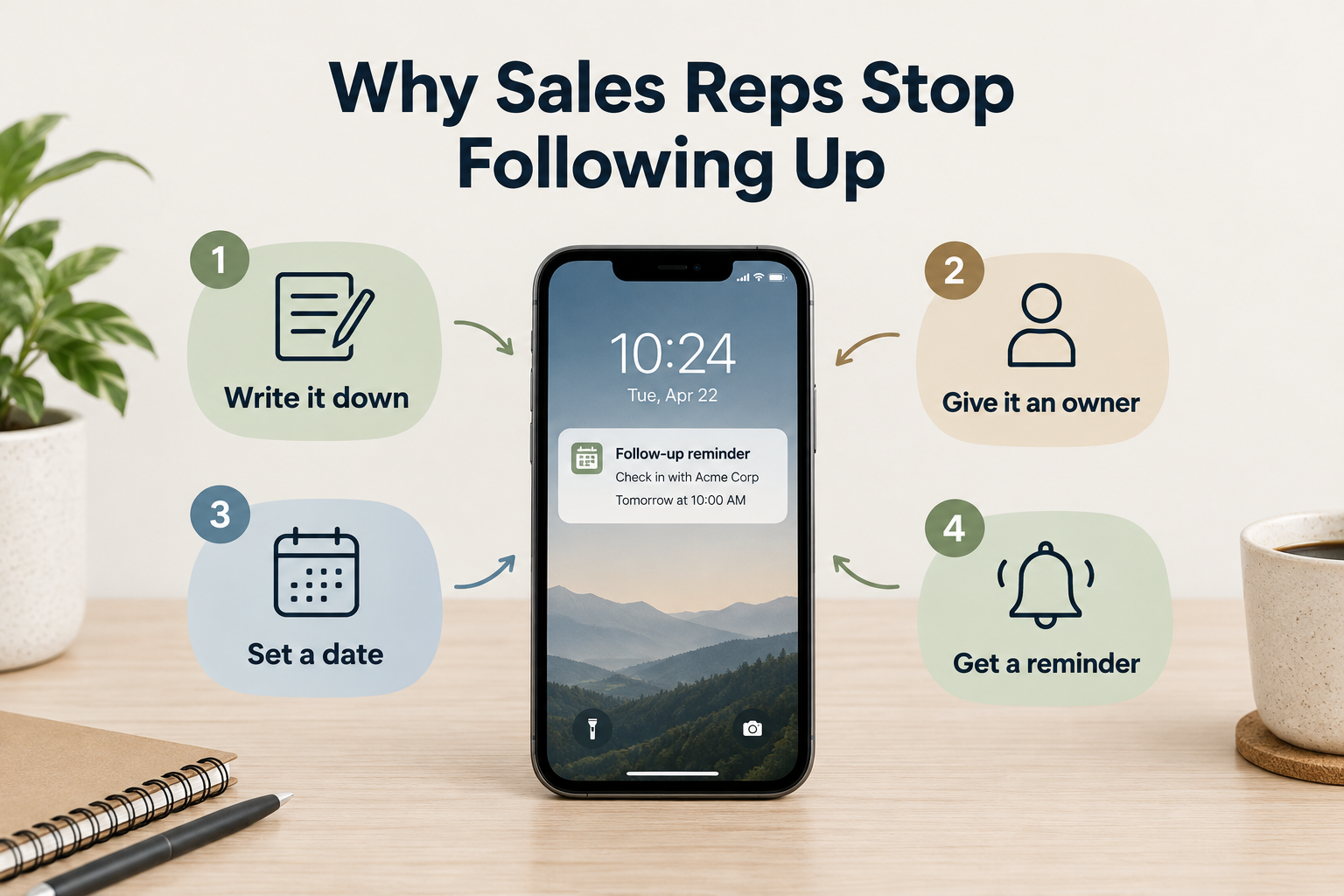
A prospect asks for details. Your rep replies, promises to check back, and then… nothing.
It is rarely laziness. Most salespeople want to close deals. The problem is usually the process around them: where the follow-up lives, who owns it, and what happens when the rep gets busy.
When you understand why follow-ups stop, you can fix the causes instead of repeating “be more disciplined” at team meetings.
Reason 1: The Follow-Up Only Exists in Their Head
A rep finishes a call and thinks, “I’ll call back Thursday.” Thursday arrives, and by then they have handled twenty more conversations.
If the commitment lives only in memory, it competes with everything else the rep is juggling. The busier the rep, the faster it disappears.
Fix: Every follow-up commitment becomes a written, dated task attached to the lead record—before the rep moves on to the next enquiry.
Reason 2: Nobody Owns the Lead
When ownership is unclear, everyone assumes someone else will contact the prospect. Or two reps follow up with the same person, and neither wants to continue after an awkward overlap.
In teams where leads are handed out informally—verbally, by chat, by whoever noticed first—follow-ups are the first thing to slip.
Fix: Give every lead one clear owner at the moment it arrives, and make reassignment an explicit, logged action a manager performs.
Reason 3: Silence Feels Like Rejection
A rep sends two messages, hears nothing, and starts to read the silence as “they’re not interested.” Continuing feels like pestering.
But silence usually means something ordinary: the prospect is busy, waiting on a decision, or planning to reconnect later.
Fix: Decide in advance how many contact attempts a quiet lead gets, and space them with a purpose—each message should offer something useful rather than ask “any update?”. When the schedule is decided by the team, not by the rep’s mood in the moment, follow-ups continue respectfully. For a practical schedule, see How Many Times Should You Follow Up With a Lead?.
Reason 4: The Context Is Gone by the Next Attempt
Weeks later, the rep opens the lead and can’t remember what was discussed. What did the prospect ask for? What was promised?
Without that context, the rep either repeats the first conversation (annoying for the prospect) or avoids the call entirely.
Fix: Record the conversation—requirements, concerns, commitments—on the lead record, not in a personal notebook. This is the foundation of tracking a lead from enquiry to sale; see How to Track Every Lead From Enquiry to Sale.
Reason 5: There Is No Visible Overdue List
Follow-ups fail quietly. A missed callback doesn’t set off an alarm. The rep doesn’t feel it; the manager doesn’t see it.
By the time anyone notices, the lead has gone weeks without contact—and is very hard to restart.
Fix: Make follow-up status visible. A rep should start each day seeing what is due today and what is already overdue. A manager should be able to spot neglected leads before they go cold. For the role of response speed in keeping leads warm, read What Is Speed-to-Lead and Why Does It Matter?.
Reason 6: The Work Happens Away From the Desk
Field and mobile-heavy teams do their calling from their phones. If follow-ups sit in a desktop-only tool, reps batch them for “when I’m back at the office”—and that moment keeps not arriving.
Fix: Put follow-ups where the work happens. A reminder that buzzes on the phone, with the lead’s name and a one-tap way to call or message, turns intention into action. See Why Sales Teams Need a Mobile CRM.
Reason 7: Every Follow-Up Starts From a Blank Page
Even when the rep remembers the task, writing the message from scratch each time feels heavy. So it gets deferred “until I have a moment.”
Fix: Give reps a starting point. A short sequence where each attempt already has a purpose—reconnect, share a resource, check timing, close respectfully—removes the blank-page problem. Start with How to Build a 7-Day Lead Follow-Up Sequence, and where AI can help prepare relevant drafts, see How AI Helps Sales Reps Follow Up With Leads.

Building a Follow-Up Process That Doesn’t Collapse
The fixes above share one theme: follow-ups should not depend on individual discipline.
A dependable process looks like this:
- One owner per lead, assigned when the lead arrives.
- Every commitment written down with a date, a channel and a purpose.
- Reminders that reach the rep where they actually work—on mobile, with a link straight to the lead.
- A visible list of today’s, upcoming and overdue follow-ups, for both rep and manager.
- A stopping rule so reps stop on replies and clear declines, not on discouragement.
- A record of each attempt so the next one continues the conversation instead of restarting it.
How Ridhzo Helps
Ridhzo addresses the specific failure points above with its documented follow-up system:
- Dated follow-ups on every lead — type (call, WhatsApp, meeting, task), notes and time, so commitments never stay in a rep’s head.
- Automatic lead assignment — round-robin, team-based, capacity-based or rule-based, so every lead has exactly one owner from the start.
- High-priority mobile reminders — push alerts with sound and badge counts, deep-linking straight to the lead’s profile so the rep can call or message in one tap.
- Today / Upcoming / Overdue views and a calendar — reps start the day with a clean queue; overdue items are segmented so they don’t snowball.
- Overdue escalation for managers — follow-ups overdue by 24 hours or more are flagged (High at 24h+, Critical at 48h+) and surfaced for oversight and redistribution.
- Going Cold detection — open leads with no contact for a configurable period (default 14 days) are surfaced with one-tap WhatsApp re-engagement and click-to-call.
- Automatic completion on answered calls — when a synced call connects, the matching follow-up closes itself; unanswered calls keep the task open so the rep tries again.
- Automations that schedule follow-ups — for example, “New lead → follow up in 1 day” or “Site visit completed → follow up in 2 days.”
FAQ
Why do most reps give up after one attempt? Usually a mix of lost context, no visible reminder, and reading silence as disinterest. These are process problems, not motivation problems.
How many follow-ups should a rep make? For a recent inbound enquiry that has gone quiet, three to five follow-ups over roughly two to three weeks is a reasonable starting point—stopped immediately if the person replies, declines or asks you to stop.
Should follow-ups be automated? Reminders and scheduling work well automated. Message content usually benefits from human review, at least until your team has tested a sequence.
What should a manager check each week? The overdue follow-up list, the Going Cold list, and whether any open leads have no next step scheduled at all.