
A potential customer asks for a quote through your website. Someone else responds to a Facebook ad. A referral sends you a WhatsApp message.
The enquiries arrive, but your team is busy. One person assumes a colleague has called. Another leaves a reminder in a notebook. A quote goes out without anyone scheduling the next conversation.
These small gaps can leave promising enquiries unattended.
A clear lead management process helps your team keep track of who needs attention, what has happened and what should happen next.
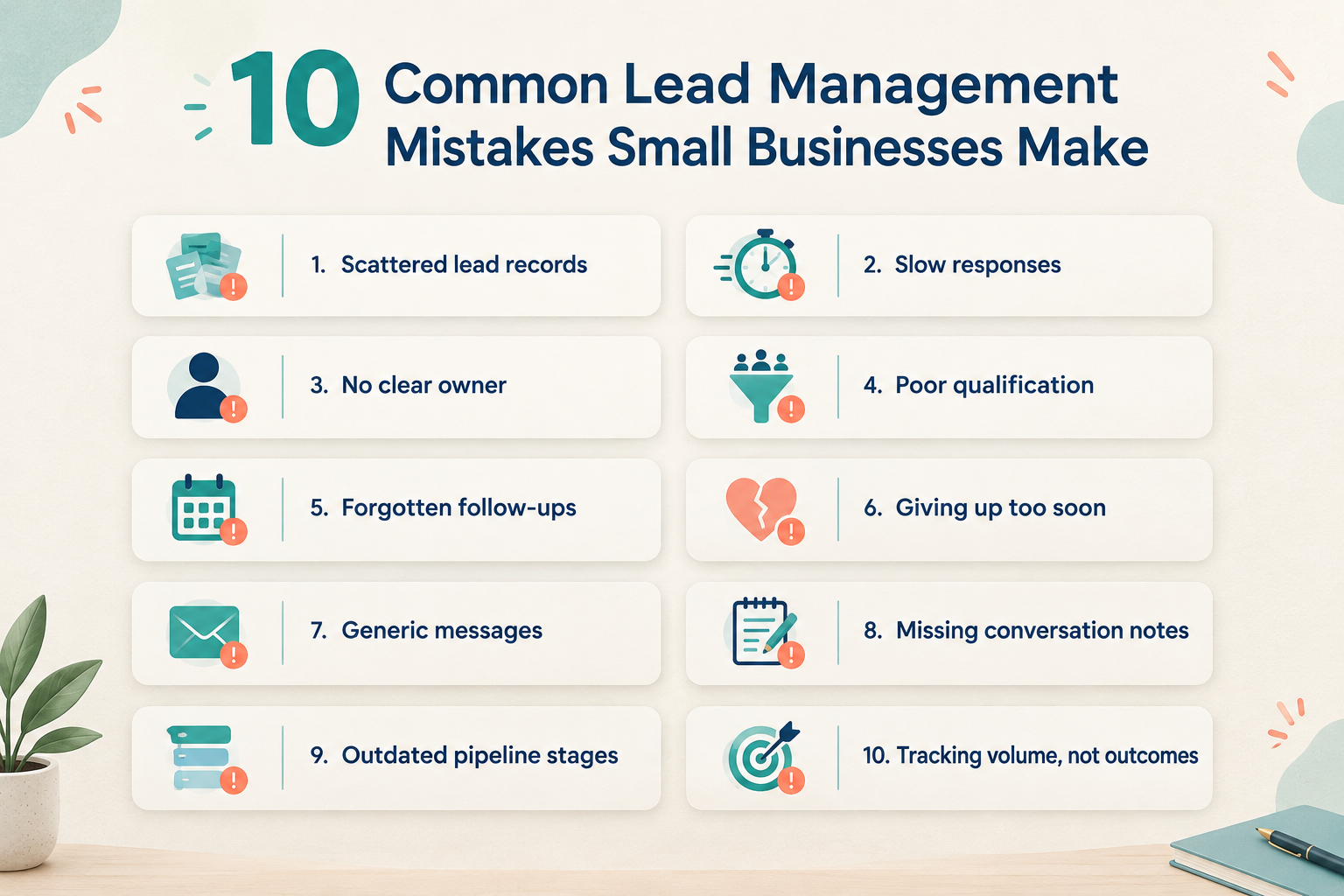
Here are ten common lead management mistakes small businesses make—and practical ways to correct them.
1. Keeping Leads Scattered Across Different Channels
When enquiries stay in separate inboxes, spreadsheets and personal phones, nobody has a complete view of the work waiting.
A sales rep might check website enquiries while missing a Facebook lead. A business owner might answer a WhatsApp message without the rest of the team knowing.
The problem becomes more noticeable when someone is absent or another person takes over a conversation.
How to fix it
Choose one shared place to record every enquiry. At minimum, capture:
- Name and contact details.
- Enquiry source.
- What the person needs.
- Assigned owner.
- Current stage.
- Next action and due date.
A spreadsheet may be enough for a small number of enquiries handled by one person. When several people or channels are involved, assess whether a CRM would make the process easier to maintain.
Where supported, connect enquiry sources to reduce manual entry. Test each connection with a sample enquiry before relying on it.
2. Responding Whenever Someone Finds Time
Checking enquiries only at the end of the day can leave people waiting while they continue comparing providers.
An automated acknowledgement can confirm that a form was received. It does not answer a question about availability, pricing or suitability.
If your team treats that acknowledgement as a completed response, an enquiry may appear handled even though nobody has spoken to the prospect.
How to fix it
Set a realistic response expectation for business hours and decide who monitors new enquiries.
For example, your team could aim to make a first contact attempt within 15 minutes during staffed hours. Treat this as an operating target you choose, rather than a universal benchmark.
For enquiries received outside working hours, explain when someone will respond and include them in the next working day’s queue.
Track automated acknowledgements separately from human contact attempts. This makes delays easier to spot.

3. Leaving Lead Ownership Unclear
“We all handle sales” can work until everyone assumes someone else has responded.
Without a named owner, enquiries may receive duplicate calls—or no call at all. Follow-ups become equally uncertain because nobody is responsible for the next step.
How to fix it
Assign one owner to every active lead.
That person should be responsible for checking the record, coordinating communication and keeping the next action up to date. Other team members can help, but responsibility should remain clear.
Decide how ownership works when:
- A new enquiry arrives.
- The assigned person is unavailable.
- A lead needs a specialist.
- The opportunity moves to another team.
A handover should include the customer’s requirements, the latest conversation and the next agreed action. Forwarding a phone number alone leaves too much work for the next person.
4. Treating Every Enquiry as Equally Ready to Buy
Someone asking for a general price range may still be exploring. Someone requesting a site visit next week has a more immediate next step.
Treating both enquiries identically can waste time and produce unhelpful conversations.
It can also lead teams to dismiss suitable prospects simply because they are not ready today.
How to fix it
Ask a few relevant questions early:
- What are you looking for?
- When do you need it?
- Where will the service or product be required?
- Is there a budget range or scope we should consider?
- Who else needs to be involved in the decision?
Keep qualification conversational. Ask only for information that helps you assess suitability or recommend a useful next step.
For example, an interior designer might first establish the property location, project scope and expected start date. Those details help determine whether to arrange a consultation or agree to reconnect later.
5. Relying on Memory for Follow-Ups
“Call next week” is an intention. It becomes actionable when someone records a date, a time and a reason.
Without a scheduled next step, follow-ups compete with incoming calls, meetings and urgent delivery work. The team ends up contacting whichever leads happen to come to mind.
How to fix it
Before finishing a meaningful conversation, record what happens next.
A useful follow-up might read:
Call Priya on Tuesday at 11 am to discuss the revised kitchen design quote and answer her questions about installation timing.
This gives the owner enough context to prepare.
Review due and overdue actions daily. If a follow-up is overdue, complete it, reschedule it with a reason or close it if it is no longer relevant.
Avoid repeatedly moving the date without checking why the conversation is not progressing.
6. Giving Up After One Unanswered Attempt
An unanswered call does not establish that someone is uninterested. They may be working, travelling or unable to answer an unfamiliar number.
At the same time, repeated calls without context can become intrusive.
The mistake is treating one failed attempt as a final answer—or continuing indefinitely without considering the prospect’s preferences.
How to fix it
Use a limited, purposeful follow-up plan.
After an unanswered call, an appropriate message could say:
Hi Aisha, this is Neha from Oak Interiors. You asked about a living room redesign through our website. I tried calling to understand your requirements. Is there a convenient time to speak?
Choose channels the prospect has provided or agreed to use. Vary the timing reasonably, make each contact useful and respect requests to stop.
Record the outcome accurately. “Call attempted—no answer” should remain distinct from “Spoke to customer.”
If there is still no response after your planned attempts, close or defer the enquiry according to your process.
7. Sending Generic Messages Without Checking the History
“Just following up” gives a prospect little reason to respond.
It is even less useful when the person has already explained what they need and the message ignores it. Asking the same questions repeatedly can make a handover feel disorganised.
How to fix it
Review the latest notes before calling or messaging.
A useful follow-up should reference the enquiry, address the current issue and suggest a clear next step.
For example:
Hi Rahul, you mentioned that weekend appointments work best. Would you like me to check availability for this Saturday?
Templates can save time, but review them before sending. Check names, requirements, dates and any claims about availability.
When using automated messages, define who should receive them and when they should stop. Verify how replies, changed circumstances, completed purchases and opt-outs affect future messages.
8. Recording Activity Without Recording What It Means
A call log tells you that a call happened. It may not tell you what the customer requested, which objection remains or what your team promised.
Similarly, “quote sent” does not explain whether the customer received it or needs a revision.
When the record contains activity without context, the next person has to reconstruct the conversation.
How to fix it
After a meaningful interaction, record three things:
- Outcome: What happened?
- Relevant context: What did you learn?
- Next action: What should happen, who owns it and when?
For example:
Customer reviewed the quote but wants a lower-cost material option. Send a revised estimate by Thursday. Call Friday afternoon after they have reviewed it.
Automatic call logging can reduce manual work, but reps still need to capture important conversation details.
Keep notes factual, business-relevant and limited to information your team needs.
9. Letting Pipeline Stages Become Inaccurate
A pipeline becomes difficult to trust when leads sit in “Interested” for months or different reps use the same stage differently.
An enquiry that has received a proposal should be distinguishable from one that has never answered a call.
Keeping lost or inactive opportunities open also makes the workload look larger than it is.
How to fix it
Start with a short pipeline based on meaningful progress:
New → Contacted → Qualified → Meeting/Quote → Decision Pending → Won/Lost
Adapt the stages to your business and define what each means.
For example, decide whether “Contacted” requires a two-way conversation. Keep unsuccessful contact attempts in the activity history rather than treating them as confirmed engagement.
Review stalled opportunities weekly. For each one, ask:
- Is the stage accurate?
- Is there a realistic next action?
- Are we waiting until an agreed date?
- Should this opportunity be closed?
Avoid creating a new stage for every task. “Send brochure” usually belongs in the next-action field.
10. Measuring Lead Volume Without Checking Outcomes
More enquiries do not automatically mean a healthier sales process.
A campaign might bring many leads that are outside your service area. Another source may bring fewer enquiries but more suitable customers.
Counting only new leads makes it harder to distinguish marketing problems from response, qualification or follow-up problems.
How to fix it
Review a small set of measures that help you decide what to change:
Use consistent definitions and allow time for your sales cycle.
For example, avoid dividing this month’s sales by this month’s new enquiries if those sales came from older leads. Compare a defined group of enquiries with that group’s eventual outcomes.
Use the findings to investigate specific gaps. Low contact rates and low proposal acceptance require different fixes.
How Ridhzo Can Support These Improvements
Once your team has agreed on the process, software can help make it easier to follow.
Ridhzo’s documented capabilities support several of the corrections above:
- Centralised capture: Bring in enquiries from supported sources, including Facebook and Instagram Lead Ads, Google Lead Form Ads and website forms.
- Assignment and alerts: Route enquiries to owners and notify the team about new leads.
- Dated follow-ups: Create follow-ups with a title, date, time, notes and type, then review Today, Upcoming, Overdue and Completed views.
- Android call syncing: Record call activity through the native Android app. Unanswered or missed calls leave follow-ups open.
- Pipeline tracking: Use custom statuses and a pipeline board to reflect your sales process.
- Automation: Use WHEN → IF → THEN workflows for documented actions such as assigning leads, changing statuses and scheduling follow-ups.
Start with one enquiry source, a clear ownership process and a manageable pipeline. Add automation after your team can explain what should happen at each step.
Frequently Asked Questions
What are the most common lead management mistakes?
Common mistakes include scattered records, slow responses, unclear ownership, weak qualification, forgotten follow-ups, generic messages and inaccurate pipeline stages. Many stem from failing to record who is responsible and what should happen next.
Can a small business manage leads without a CRM?
Yes. A shared spreadsheet can work for a low-volume process with clear ownership and consistent updates. Consider a CRM when multiple channels, team handovers and reminders become difficult to manage manually.
How many times should you follow up with a lead?
There is no single number that fits every business. Base your plan on the enquiry, buying timeline, contact preferences and response history. Make each attempt useful, and stop when someone asks you to.
How can I tell whether the problem is lead quality or lead management?
Review suitability and handling separately. Check whether enquiries match your offer and service area, then examine response times, contact attempts, ownership and follow-up completion. Poor outcomes can reflect problems in either area—or both.
Start by Checking Your Open Leads
You do not need to redesign your entire sales process today.
Review your active enquiries and check whether each has an owner, an accurate stage and a dated next action. Fix those gaps first.
If maintaining that process across inboxes and spreadsheets is becoming difficult, explore Ridhzo with one real enquiry journey—from capture through follow-up to the final outcome.